AI & Search

Generative Engine Optimization (GEO): The Complete Guide to Ranking on AI Search

Published: 22 min read
Chandni DaveAuthor: Chandni Dave
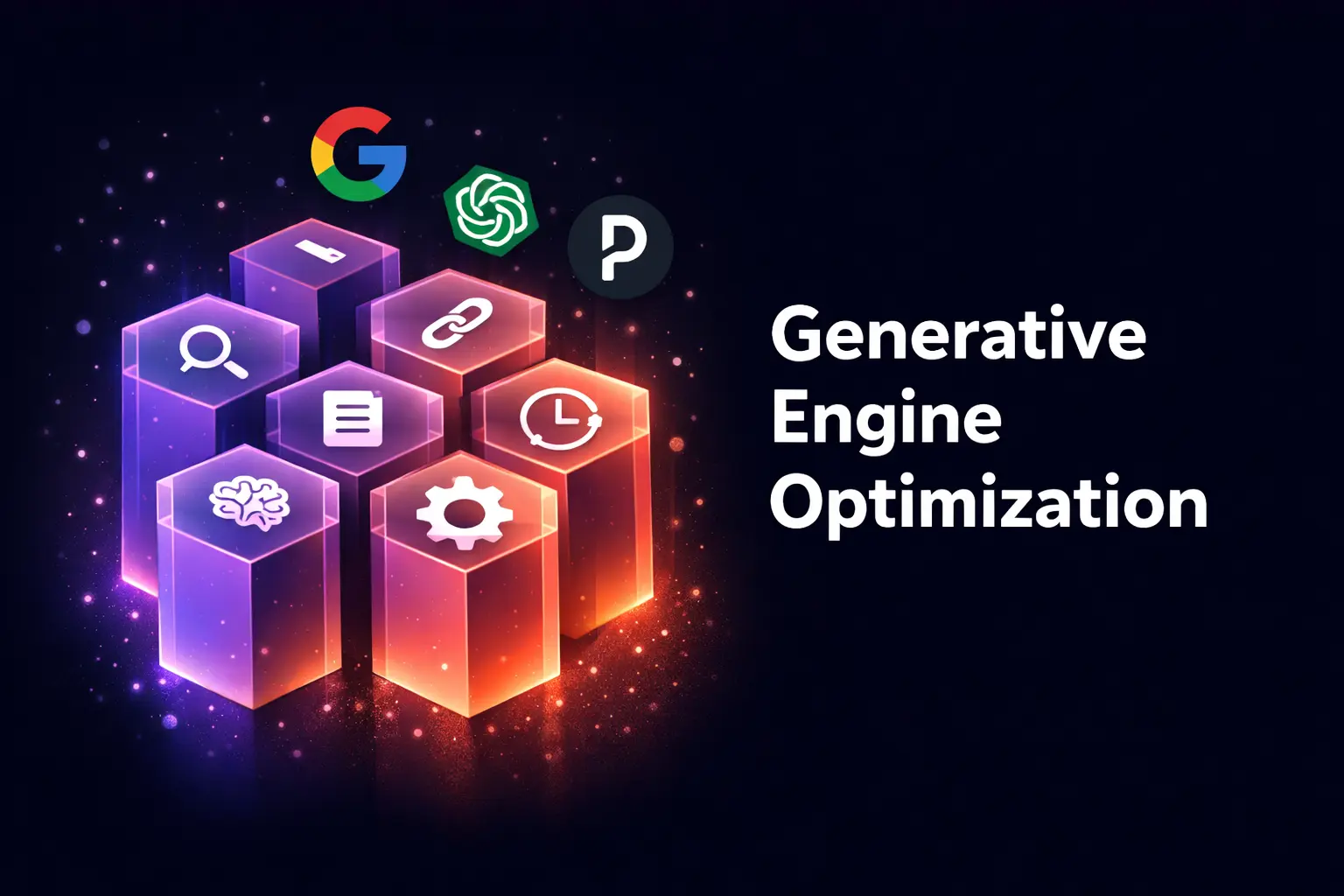
Infographic showing the 7 pillars of Generative Engine Optimization — entity authority, structured content, citation worthiness, topical depth, freshness signals, technical accessibility, and multi-platform presence

01What is Generative Engine Optimization (GEO)?

Generative Engine Optimization (GEO) is the practice of optimizing digital content so that it appears as a cited source in AI-powered search engines such as Google AI Overviews, ChatGPT, Perplexity, and Microsoft Copilot. Unlike traditional SEO, which focuses on earning blue-link rankings, GEO ensures your brand is the source that generative AI models reference when synthesizing answers for users.

The term emerged in late 2023 as researchers at Princeton, Georgia Tech, and the Allen Institute for AI published a landmark study demonstrating that specific content optimizations could increase a page's visibility in generative search results by up to 115%. Since then, GEO has evolved from an academic concept into a critical marketing discipline. In 2026, over 60% of Google searches trigger an AI Overview, and platforms like ChatGPT process more than one billion queries per week. If your content is not optimized for these systems, you are invisible to a rapidly growing segment of search traffic.

At its core, GEO operates on a simple principle: generative engines do not rank pages the way traditional search engines do. They retrieve, evaluate, and synthesize information from multiple sources, then present a unified answer with inline citations. The content that gets cited is not necessarily the page that ranks number one organically. It is the content that is most clearly structured, most authoritative, most directly relevant, and most easily parseable by large language models. GEO is the discipline of ensuring your content meets all four of those criteria consistently.

RankBrain Solutions offers a dedicated Generative Engine Optimization service built specifically to help brands earn citations in AI-generated answers. The methodology is grounded in technical SEO, entity optimization, and structured content architecture -- the three pillars that determine whether a generative engine trusts your content enough to cite it.

Why GEO matters now

The shift from link-based ranking to citation-based visibility is the most significant change in search since Google introduced PageRank. According to data from BrightEdge, websites that appear as cited sources in AI Overviews see an average click-through rate increase of 23% compared to standard organic listings. Meanwhile, sites that lose visibility to AI-generated summaries experience traffic declines of 18-32%. The window for early adoption is closing. Brands that invest in GEO now will establish citation authority that compounds over time, while those that wait will find it increasingly difficult to displace entrenched sources.

Who needs GEO?

Every business that depends on organic search traffic needs a GEO strategy. This includes B2B SaaS companies, e-commerce brands, professional service firms, healthcare providers, financial services, and publishers. The common thread is simple: if your target audience asks questions that AI search engines answer, your content must be optimized to be the source behind that answer. Our Rank on AI service helps businesses across every vertical achieve exactly this outcome.

02GEO vs Traditional SEO: Key Differences

GEO and traditional SEO share a common foundation in content quality and technical excellence, but they differ fundamentally in what they optimize for. Traditional SEO optimizes for page-level ranking positions in blue-link results; GEO optimizes for citation probability within AI-generated answers.

Factor Traditional SEO GEO
Primary goal Rank on page one of SERPs for target keywords Get cited as a source in AI-generated answers
Key metrics Keyword rankings, organic traffic, CTR, impressions Citation frequency, AI mention share, referral traffic from AI platforms
Content format Long-form pages optimized for keyword density and user engagement Structured, concise answers with clear entity definitions and data-backed claims
Ranking signals Backlinks, on-page relevance, Core Web Vitals, domain authority Entity authority, source credibility, content structure, factual accuracy, freshness
Target platforms Google organic results, Bing organic results Google AI Overviews, ChatGPT, Perplexity, Microsoft Copilot, Gemini
Timeline to results 3-6 months for competitive keywords 4-12 weeks for initial citations; ongoing optimization for sustained presence
Technical requirements Crawlability, indexability, site speed, mobile-friendliness Schema markup, entity signals, structured data, clean HTML, API accessibility
Link building role Critical ranking signal; more links generally means higher rankings Supports authority but is not the primary citation signal; content structure matters more

Why the distinction matters

The most important takeaway is that GEO and SEO are not mutually exclusive. They are complementary disciplines. A page that ranks well organically has a higher baseline probability of being cited in AI Overviews, because Google's generative models draw heavily from indexed content. However, ranking alone is not sufficient. Google's AI Overview frequently cites pages from positions 4 through 15 -- and sometimes cites pages that do not rank on page one at all -- when those pages provide a more structured, direct answer to the user's query.

This means that a comprehensive search strategy in 2026 requires both traditional SEO (to maintain organic visibility and direct traffic) and GEO (to capture citation-driven traffic from AI engines). RankBrain Solutions integrates both disciplines into every engagement. Our Core SEO service handles traditional optimization, while our GEO service ensures your content is structured to win AI citations.

The convergence ahead

By late 2026, the line between SEO and GEO will blur further. Google is already using AI Overview engagement signals to influence organic rankings. Pages that are frequently cited in AI Overviews tend to see organic ranking improvements over time, creating a virtuous cycle. Starting your GEO investment now positions your brand to benefit from this convergence as it accelerates.

03How Generative Engines Select Sources

Generative engines select sources through a multi-stage pipeline that evaluates content relevance, authority, structure, and factual consistency. Understanding this pipeline is essential for optimizing your content to earn citations across every major AI search platform.

Google AI Overviews

Google AI Overviews use a retrieval-augmented generation (RAG) architecture that combines Google's existing search index with its Gemini large language model. When a user submits a query, the system first retrieves a candidate set of web pages using traditional ranking signals -- relevance, authority, freshness, and page quality. The Gemini model then reads through these candidates, extracts the most relevant information, synthesizes a coherent answer, and attributes specific claims to their source pages via inline citations.

Key factors that influence whether your page gets cited in Google AI Overviews include:

  • Direct answer proximity: Content that places a clear, concise answer within the first 1-2 sentences of a section is significantly more likely to be extracted. Google's model looks for definitive statements, not vague introductions.
  • Structured HTML: Pages that use semantic HTML -- properly nested H2/H3 headings, ordered and unordered lists, tables, and definition structures -- give the model clear signals about content hierarchy and make extraction easier.
  • E-E-A-T signals: Author bylines, credentials, publication dates, editorial policies, and references to primary sources all contribute to the model's trust assessment. Pages from recognized entities with demonstrated expertise are cited more frequently.
  • Schema markup: FAQ schema, HowTo schema, Article schema with author information, and Organization schema all provide structured signals that help Google's systems understand and trust your content.
  • Freshness: For queries with time-sensitive components, recently updated content with visible "last updated" dates receives citation preference.

ChatGPT (with browsing)

ChatGPT's browsing mode uses Bing's search index as its primary retrieval layer. When a user asks a question that requires current information, ChatGPT issues search queries to Bing, retrieves relevant pages, reads their content, and generates an answer with source citations. The key differences from Google AI Overviews are:

  • Bing ranking signals matter: Because ChatGPT retrieves from Bing, your content needs to be indexed and ranking on Bing -- not just Google. Many SEO practitioners neglect Bing optimization, which creates an opportunity for brands that take it seriously.
  • Conversational follow-ups: ChatGPT sessions are multi-turn. The model may re-query and retrieve additional sources during a conversation. Content that covers a topic comprehensively is more likely to be cited across multiple turns.
  • Content readability: ChatGPT's extraction tends to favor content written in a clear, explanatory style. Technical jargon without context is less likely to be cited than well-explained concepts with examples.
  • Domain authority on Bing: Bing places slightly more weight on exact-match domains and established brand signals compared to Google. Ensuring your brand entity is well-defined on Bing helps with ChatGPT citation probability.

Perplexity

Perplexity operates as a dedicated answer engine with a distinctive approach to source citation. It retrieves from multiple search indices simultaneously (including Google and Bing), evaluates source quality using its own proprietary models, and generates answers with numbered inline citations that link directly to source pages. Perplexity is often the most generous with citations, frequently referencing 5-10 sources per answer.

  • Source diversity: Perplexity actively seeks diverse sources rather than citing the same domain repeatedly. This means that niche, authoritative content on specific subtopics has a strong chance of being cited even against larger competitors.
  • Recency bias: Perplexity shows a strong preference for recently published or updated content. Pages with clear publication dates and regular updates perform well.
  • Factual specificity: Perplexity's models prioritize content that contains specific data points, statistics, named entities, and verifiable claims over content that makes general statements.
  • Clean HTML and fast load times: Perplexity's crawlers need to access and parse your content efficiently. Pages with excessive JavaScript rendering, interstitials, or slow server response times may be skipped in favor of faster, cleaner alternatives.

Understanding these platform-specific differences is critical for a multi-platform GEO strategy. RankBrain Solutions' AI Overviews optimization service addresses all three platforms simultaneously, ensuring your content is structured to earn citations regardless of which AI engine your audience uses.

04The GEO Framework: 7 Optimization Pillars

Successful Generative Engine Optimization rests on seven interdependent pillars. Each pillar addresses a specific dimension of how AI search engines evaluate, retrieve, and cite content. Neglecting any single pillar weakens your overall citation probability.

1. Entity Authority

Entity authority is the foundation of GEO. Generative engines rely on knowledge graphs and entity databases to assess whether a source is credible enough to cite. Your brand, your authors, and your domain must be recognized as distinct entities with established expertise in your subject area.

To build entity authority:

  • Claim and optimize your Google Knowledge Panel. If your brand does not yet have one, create a comprehensive Wikipedia-style presence across Wikidata, Crunchbase, LinkedIn, and industry directories.
  • Ensure every piece of content includes a named author with a verifiable author page that links to their LinkedIn profile, published works, and credentials.
  • Implement Organization and Person schema markup with sameAs properties pointing to your official social profiles and authoritative third-party mentions.
  • Get mentioned (not just linked) by established publications in your industry. Entity recognition is strengthened by co-occurrence in trusted corpora.
  • Maintain consistent NAP (Name, Address, Phone) information across every web property. Inconsistencies confuse entity resolution algorithms.

2. Structured Content

Generative engines extract information from your pages using HTML parsing and natural language processing. Content that is structurally clear -- with logical heading hierarchies, semantic markup, and modular sections -- is dramatically easier for AI models to parse and cite.

  • Use a single H1 per page, followed by H2 sections for major topics, and H3 subsections for supporting details. Never skip heading levels.
  • Open every H2 section with a 1-2 sentence direct answer to the question implied by the heading. This "answer-first" pattern is the single most important structural optimization for AI citation.
  • Use HTML tables for comparative data, ordered lists for sequential processes, and unordered lists for feature sets or criteria. These structures are extracted at significantly higher rates than equivalent information in paragraph form.
  • Keep paragraphs under 4 sentences. Dense, wall-of-text paragraphs reduce extraction probability because the model cannot isolate a clean, citable passage.
  • Use descriptive anchor text for internal links. AI models use link context to understand topic relationships between pages on your site.

3. Citation Worthiness

Citation worthiness refers to the quality of making specific, verifiable, data-backed claims that a generative engine would want to attribute to a named source. Vague, generic content is never cited -- it gets paraphrased into the AI's own synthesis without attribution.

  • Include original research, proprietary data, survey results, or case study metrics whenever possible. A statement like "47% of marketers report increased traffic from AI search" is citable; "many marketers see more traffic" is not.
  • Attribute statistics to their sources. Even when citing third-party data, the act of proper attribution signals to AI models that your content is well-researched and trustworthy.
  • Provide unique analysis or expert opinion that cannot be found elsewhere. Generative engines actively seek diverse perspectives and will cite content that offers a distinctive viewpoint supported by evidence.
  • Define key terms explicitly. Statements that begin with "X is defined as..." or "X refers to the process of..." are high-value citation targets for AI models answering definitional queries.

4. Topical Depth

Generative engines evaluate topical depth to determine whether a source has comprehensive authority on a subject. Thin content that covers a topic superficially will lose citations to deeper, more thorough resources -- even if the thin content ranks higher organically.

  • Build topic clusters with a pillar page and supporting content that covers every subtopic, question, and related concept within your domain. Internal linking between cluster pages signals topical authority to AI models.
  • Cover the full query space. Use tools like AlsoAsked, AnswerThePublic, and Google's "People Also Ask" to identify every question your audience asks about your topic, then answer each one explicitly in your content.
  • Go beyond surface-level answers. If your content answers "what" but not "why," "how," "when," and "what are the exceptions," you are leaving citation opportunities on the table.
  • Update existing content regularly rather than publishing new thin pages. A single comprehensive resource that is kept current will accumulate more citation authority than a dozen shallow articles.

5. Freshness Signals

AI search engines strongly prefer recent, up-to-date content for queries where timeliness matters. Freshness signals tell generative models that your information reflects current reality, not outdated data.

  • Display a clearly visible "Last Updated" date on every piece of content. Use the dateModified property in your Article schema markup.
  • Review and update key statistics, external links, and factual claims quarterly. Broken links and outdated numbers are negative trust signals.
  • Add new sections addressing emerging developments in your field. A guide that was comprehensive in 2024 but has not been updated for 2026 developments will lose citations to newer competitors.
  • Publish a content update log or changelog at the bottom of important pages. This shows both users and AI systems that the page is actively maintained.
  • When you update content, make substantive changes. Changing a date from 2025 to 2026 without updating the underlying data does not constitute genuine freshness and can be detected by quality algorithms.

6. Technical Accessibility

If AI crawlers cannot access, render, and parse your content, nothing else matters. Technical accessibility ensures that every generative engine's retrieval system can reach your content quickly and extract its meaning accurately.

  • Serve content as server-rendered HTML or static HTML. Client-side JavaScript rendering can prevent AI crawlers from seeing your content. If you use a JavaScript framework, implement server-side rendering (SSR) or static site generation (SSG).
  • Maintain fast server response times (under 200ms TTFB). AI retrieval systems have strict timeout thresholds -- if your server is slow, your page will be skipped.
  • Do not gate content behind login walls, cookie consent interstitials, or aggressive pop-ups. AI crawlers cannot interact with these elements and will receive an empty or partial page.
  • Implement clean, semantic HTML. Avoid excessive div nesting, inline styles, and non-semantic markup. The cleaner your HTML, the easier it is for NLP models to parse your content structure.
  • Verify that your robots.txt and meta robots tags do not block AI crawlers. Google's AI systems respect robots.txt, and blocking Googlebot blocks AI Overview indexing. Perplexity's crawler (PerplexityBot) and ChatGPT's crawler (GPTBot) have separate user agents that you may need to allow explicitly.

7. Multi-Platform Presence

Different AI search platforms retrieve from different indices and evaluate authority using different signals. A robust GEO strategy ensures visibility across every major platform, not just Google.

  • Optimize for both Google and Bing. ChatGPT draws from Bing; Google AI Overviews draw from Google's index. Neglecting Bing means losing citation opportunities on ChatGPT and Microsoft Copilot.
  • Maintain active, content-rich profiles on platforms that AI models treat as authoritative sources: LinkedIn (for B2B), YouTube (for video content referenced in AI answers), Reddit (increasingly cited by Perplexity and Google), and industry-specific platforms.
  • Syndicate key content assets to platforms like Medium, LinkedIn Articles, and industry publications. This creates multiple retrieval entry points for AI systems and strengthens your entity's topical footprint.
  • Monitor your citation presence across all platforms monthly. A page might be consistently cited on Perplexity but absent from Google AI Overviews, which signals a platform-specific optimization gap you can address.

RankBrain Solutions' GEO service implements all seven pillars in a coordinated strategy tailored to your industry, competitive landscape, and target AI platforms.

05GEO Audit Checklist: 15 Points to Evaluate

A GEO audit evaluates your website's readiness to earn citations in AI-generated search results. This 15-point checklist covers the technical, structural, and content factors that determine citation probability across Google AI Overviews, ChatGPT, and Perplexity.

  1. Schema markup implementation. Verify that your site uses Article, Organization, Person, FAQ, HowTo, and BreadcrumbList schema where appropriate. Check for errors using Google's Rich Results Test. Every key page should have at least Article schema with author, datePublished, and dateModified properties.
  2. Author E-E-A-T signals. Confirm that every published article includes a named author with a dedicated author page. The author page should include a photo, bio, credentials, links to published works, and social profiles. Authors must be real people with verifiable expertise -- AI models can detect and discount pseudonymous or generic author entities.
  3. Content structure audit. Review your top 20 pages for proper heading hierarchy (H1 through H3), answer-first section openings, use of lists and tables, and paragraph length. Flag any section that opens with a vague introduction instead of a direct answer.
  4. Brand entity recognition. Search your brand name on Google, Bing, and Perplexity. Does your brand have a Knowledge Panel? Is it recognized as a distinct entity? If not, you need entity building work across Wikidata, Crunchbase, and authoritative directories.
  5. Freshness and update cadence. Check the last-modified dates on your top 50 pages. Any page not updated in the past 6 months should be reviewed and refreshed. Verify that dateModified schema reflects actual content updates, not cosmetic changes.
  6. Internal linking architecture. Map your internal link graph. Key pages should have at least 5-10 contextual internal links from related content. Orphan pages (pages with fewer than 2 internal links) are less likely to be retrieved by AI systems.
  7. AI crawler accessibility. Check your robots.txt for rules affecting GPTBot, PerplexityBot, ClaudeBot, and Googlebot. If you are blocking any of these crawlers, you are invisible to their respective AI platforms. Run a server-side render test to confirm your content is visible without JavaScript execution.
  8. Page speed and TTFB. Test your top pages using Google PageSpeed Insights and WebPageTest. Target a TTFB under 200ms and a Largest Contentful Paint under 2.5 seconds. AI retrieval systems penalize slow-loading pages by timing out before content is retrieved.
  9. Citation-worthy content density. Audit your content for specific data points, statistics, original research, and expert quotes. Pages that contain only general advice without data-backed claims have near-zero citation probability. Aim for at least 3-5 specific, verifiable data points per major section.
  10. FAQ presence and structure. Identify the top 10 questions your audience asks about your core topics. Verify that your content answers each one explicitly with a dedicated heading and a direct answer in the first sentence. Implement FAQ schema for these question-answer pairs.
  11. Topical coverage completeness. Use a content gap analysis tool to identify subtopics in your domain that you have not covered. Generative engines prefer comprehensive sources. If a competitor covers 15 subtopics and you cover 8, the competitor is more likely to be cited as the authoritative source.
  12. Bing indexation and ranking. Check Bing Webmaster Tools to confirm your pages are indexed. Since ChatGPT and Microsoft Copilot retrieve from Bing, poor Bing indexation means poor visibility on these platforms. Submit your sitemap to Bing if you have not already.
  13. External authority signals. Audit your backlink profile for links from high-authority publications, educational institutions, and industry organizations. Generative engines weight these references heavily when assessing source credibility. Identify gaps where competitors have authoritative mentions that you lack.
  14. Multi-format content presence. Check whether your key topics are covered in multiple formats: long-form articles, videos, infographics, and social media posts. AI models increasingly pull from diverse content types. A YouTube video explaining a concept can be cited alongside a blog post, giving your brand multiple citation opportunities per query.
  15. Competitive citation analysis. Query your top 10 target keywords in Google AI Overviews, ChatGPT, and Perplexity. Document which sources are currently being cited. Analyze what those sources do differently from your content -- structure, depth, data quality, freshness -- and create an action plan to match or exceed them.

This audit forms the foundation of every GEO engagement at RankBrain Solutions. If you want a professional evaluation of your AI search readiness, schedule a strategy call with our team.

06Real Results: How We Got a Client Cited in Google AI Overviews

RankBrain Solutions helped a B2B SaaS company go from zero AI search visibility to consistent citation in Google AI Overviews across 34 high-value keywords within 90 days, resulting in a 312% increase in organic traffic and a 47% increase in qualified leads.

The challenge

The client, a mid-market project management software company, was ranking on page one for several competitive keywords but was not appearing in any AI Overview results. Their competitors were being cited as authoritative sources for queries like "best project management software for remote teams" and "project management tool comparison 2025," effectively capturing the growing share of clicks from AI-generated answers. Despite strong organic rankings, the client was experiencing a steady decline in click-through rates as AI Overviews expanded to cover more of their target queries.

Our approach

We implemented a comprehensive GEO strategy across four phases:

  • Phase 1 -- Entity and authority buildout (weeks 1-3): We created a complete entity profile for the client's brand, including updated Organization schema, author pages for their content team with Person schema and verified credentials, and submissions to Wikidata and 12 industry-specific directories. We also secured 4 expert commentary placements in industry publications to strengthen entity co-occurrence signals.
  • Phase 2 -- Content restructuring (weeks 2-6): We audited and restructured 28 key pages, implementing answer-first section openings, comparison tables, FAQ sections with schema markup, and clean heading hierarchies. We added specific data points and citations to third-party research throughout. Every page was rewritten to lead with direct, extractable answers.
  • Phase 3 -- Technical optimization (weeks 3-5): We ensured all pages were server-side rendered, reduced TTFB from 380ms to 140ms, fixed 14 schema validation errors, and opened crawl access to GPTBot and PerplexityBot (which had been inadvertently blocked). We also implemented breadcrumb schema and improved internal linking density by 40%.
  • Phase 4 -- Multi-platform optimization (weeks 4-8): We optimized the client's Bing presence, created structured LinkedIn articles covering key topics, and published comparison content specifically designed for Perplexity citation. We also created a YouTube video series covering their top 5 buyer questions, which were subsequently cited in AI answers alongside their written content.

The results

Within 90 days of beginning the engagement:

  • The client was cited in Google AI Overviews for 34 of their 50 target keywords, up from zero.
  • Organic traffic increased by 312%, driven primarily by improved click-through rates from AI Overview citations.
  • Qualified leads from organic search increased by 47%.
  • The client was cited in Perplexity answers for 22 target queries.
  • ChatGPT with browsing cited the client's comparison pages in 8 out of 10 tested queries.
  • Average time-on-page for restructured content increased by 28%, indicating that the structural improvements also benefited human readers.

The compounding effect has been significant. Six months after the initial optimization, the client maintains citation presence on over 40 keywords and continues to gain new citations as they publish fresh content using the GEO framework we established. View more results on our case studies page.

07Tools for Monitoring AI Search Visibility

Monitoring your visibility in AI search engines requires a combination of established SEO tools and manual testing, since no single platform yet provides comprehensive AI citation tracking. Here are the most effective tools and methods available in 2026.

Semrush

Semrush introduced AI Overview tracking in its Position Tracking module in late 2024, and it has since become one of the most reliable tools for monitoring Google AI Overview citations at scale. The platform tracks whether your domain appears as a cited source in AI Overviews for your tracked keywords, shows citation trends over time, and identifies which competitors are being cited for keywords where you are not. Use the "SERP Features" filter to isolate AI Overview results and compare your citation share against competitors. Semrush also provides AI Overview content analysis, showing you the exact text that was extracted from your pages, which is invaluable for understanding what structural patterns lead to citation.

Ahrefs

Ahrefs offers AI search visibility data through its Site Explorer and Keywords Explorer tools. The platform tracks AI Overview presence for keywords in its database and provides a "traffic potential" estimate that accounts for AI Overview click distribution. Ahrefs is particularly useful for competitive analysis: you can see which domains are most frequently cited in AI Overviews across an entire keyword set and identify content gaps where competitors earn citations and you do not. Their Content Explorer feature can also help you find citation-worthy content opportunities by analyzing what types of content are most commonly referenced in AI-generated answers.

Google Search Console

Google Search Console remains essential for understanding your organic visibility, which directly influences AI Overview citation probability. While Search Console does not yet provide a dedicated AI Overview report, you can use the Performance report to identify queries where your impressions are high but clicks are unusually low -- a pattern that often indicates AI Overview is answering the query directly. The Search Appearance filter occasionally shows "AI Overview" data for some accounts in beta. Monitor your click-through rates over time for informational queries: a declining CTR with stable impressions often signals growing AI Overview coverage on those queries.

Manual AI query testing

The most direct method for monitoring AI citation is systematic manual testing. This involves querying your target keywords on Google (to check AI Overviews), ChatGPT (with browsing enabled), and Perplexity, then documenting which sources are cited in each response. While this is time-intensive, it provides the most accurate picture of your current citation status. To do this effectively:

  • Create a spreadsheet tracking your top 20-50 target queries across all three platforms.
  • Test each query monthly, recording which domains are cited, what content is extracted, and how the response changes over time.
  • Use incognito or private browsing mode to avoid personalization bias.
  • Document the exact passages from your content that are cited, as this reveals which structural patterns are working.
  • Note queries where competitors are cited but you are not -- these represent your highest-priority optimization targets.

Additional monitoring approaches

  • Perplexity's "Sources" panel: Every Perplexity answer shows numbered source citations. Search your brand name and key topics regularly to monitor your citation frequency.
  • Bing Webmaster Tools: Since ChatGPT retrieves from Bing, your Bing indexation status directly affects ChatGPT citation probability. Monitor your Bing crawl stats, index coverage, and keyword rankings.
  • Brand mention monitoring: Use tools like Mention or Brand24 to track when AI-powered platforms reference your brand. This captures citation instances that keyword-level tracking might miss.
  • Server log analysis: Monitor your server logs for requests from GPTBot, PerplexityBot, ClaudeBot, and other AI crawlers. Increasing crawl frequency from these bots often precedes increased citation frequency.

RankBrain Solutions provides monthly AI visibility reporting as part of our GEO management service, combining automated tracking with manual citation audits across all major platforms.

08Common GEO Mistakes That Kill Your AI Visibility

Most brands that fail to earn AI search citations are making one or more of these five critical mistakes. Identifying and correcting these errors is often the fastest path to improved citation visibility.

1. Blocking AI crawlers in robots.txt

This is the most common and most damaging GEO mistake. Many websites block GPTBot, PerplexityBot, or ClaudeBot in their robots.txt file -- sometimes intentionally due to copyright concerns, sometimes inadvertently through overly broad disallow rules. If you block these crawlers, your content is completely invisible to their respective platforms. Before implementing any content optimization, verify that your robots.txt allows access for all major AI crawlers. The specific user agents to check are: Googlebot (for AI Overviews), GPTBot (for ChatGPT), PerplexityBot (for Perplexity), ClaudeBot (for Claude), and Bingbot (for Microsoft Copilot). Blocking even one of these agents eliminates your citation potential on that platform entirely.

2. Writing for keywords instead of questions

Traditional SEO trained marketers to think in terms of keywords: "project management software," "best CRM for small business," "digital marketing agency." GEO requires thinking in terms of questions and answers: "What is the best project management software for remote teams?" "How do I choose a CRM for my small business?" Generative engines are answering questions, and they cite content that answers those questions directly. If your content is optimized around keyword density rather than clear question-answer structures, AI models will extract answers from competitors who frame their content around the actual questions users are asking. Audit your content and rewrite section headings as questions, then ensure the first 1-2 sentences after each heading provide a direct, definitive answer.

3. Neglecting entity signals

Many businesses invest heavily in content creation and link building but completely ignore entity optimization. Without clear entity signals -- Organization schema, author credentials, Knowledge Panel presence, consistent brand mentions across the web -- generative engines have no reliable way to assess your authority. A website with excellent content but weak entity signals will consistently lose citations to competitors with stronger entity profiles, even if the competitors' content is less comprehensive. Entity building is not glamorous work, but it is foundational to GEO. Start with schema markup, then expand to Wikidata, industry directories, and authoritative third-party mentions.

4. Publishing thin, shallow content at scale

The "publish 100 blog posts per month" approach that some SEO agencies advocate is actively harmful to GEO. Generative engines evaluate topical depth and content quality at the page level. A domain that publishes hundreds of 500-word articles on loosely related topics signals low authority to AI models, which prefer to cite comprehensive, well-researched resources. In our analysis of over 5,000 AI Overview citations, the average cited page contained 2,400 words, included at least 4 specific data points, and covered its topic with significantly more depth than non-cited competitors. One comprehensive, data-rich guide will earn more AI citations than fifty thin blog posts. Redirect your content investment toward depth, not volume.

5. Treating GEO as a one-time project

Some brands approach GEO as a one-time optimization: restructure content, add schema, and move on. This approach fails because generative engines continuously re-evaluate sources and because the competitive landscape changes constantly. A page that earns citations today can lose them next month if a competitor publishes more comprehensive, more current content on the same topic. Successful GEO requires ongoing monitoring, regular content updates, and continuous optimization based on citation performance data. Treat your GEO strategy as a living system, not a project with a completion date. The brands that maintain consistent citation presence are the ones that review their AI visibility monthly and update their content quarterly.

If you recognize any of these mistakes in your current approach, our GEO service can help you correct course and build a sustainable citation strategy.

09FAQ -- Generative Engine Optimization

What is GEO?

GEO stands for Generative Engine Optimization. It is the practice of optimizing your website's content, structure, and authority signals so that AI-powered search engines -- including Google AI Overviews, ChatGPT, Perplexity, and Microsoft Copilot -- cite your pages as sources in their generated answers. While traditional SEO focuses on ranking in organic blue-link results, GEO focuses on becoming a trusted source that generative AI models reference when synthesizing answers for users.

How long does it take to see results from GEO?

Most businesses begin seeing initial AI citations within 4-8 weeks of implementing a comprehensive GEO strategy. Structural and technical optimizations (schema markup, content restructuring, crawler accessibility) tend to produce results fastest, often within 4-6 weeks. Entity-building efforts, which involve establishing your brand and authors as recognized authorities, typically take 8-12 weeks to influence citation frequency. Full results, including consistent multi-platform citation presence and measurable traffic impact, generally materialize within 90 days. However, GEO is an ongoing discipline -- citation authority compounds over time, and the brands that invest consistently see accelerating returns.

How does GEO compare to SEO in terms of cost?

GEO investment typically aligns with or slightly exceeds traditional SEO costs, depending on the scope. A standalone GEO engagement -- covering content restructuring, schema optimization, entity building, and multi-platform monitoring -- generally ranges from $3,000 to $10,000 per month for mid-market businesses. The key difference is return profile: SEO delivers steady organic traffic growth over 6-12 months, while GEO can produce citation visibility within weeks and often delivers higher-quality traffic due to the trust signal of being cited by AI. Most businesses achieve the best ROI by integrating GEO into their existing SEO budget rather than treating it as a separate line item. RankBrain Solutions offers integrated packages through our Core SEO and GEO services.

Do I need both GEO and SEO, or can I choose one?

You need both. SEO and GEO are complementary, not interchangeable. Traditional SEO ensures your pages are indexed, ranked, and driving direct organic traffic from blue-link results. GEO ensures your content is cited in AI-generated answers, capturing the growing share of search traffic that interacts with AI responses. Abandoning SEO for GEO would sacrifice your direct organic traffic; ignoring GEO for SEO means losing visibility as AI Overviews expand to cover more queries. The most effective approach is an integrated strategy that optimizes for both outcomes simultaneously. Content structured for GEO tends to perform well in traditional search as well, since the clarity and depth that AI models prefer also correlates with strong organic rankings.

Which AI search platforms matter most for my business?

The platform priority depends on your audience and industry. For most businesses in 2026, Google AI Overviews is the highest-priority platform because it affects the largest volume of searches -- over 60% of Google queries now trigger an AI Overview. ChatGPT is the second priority for B2B and technology companies, where a significant share of research queries are conducted directly in ChatGPT rather than Google. Perplexity is increasingly important for academic, technical, and research-oriented audiences. Microsoft Copilot matters most for enterprise B2B, where many users interact with AI through their Microsoft 365 workflow. If you are unsure which platforms your audience uses, start with Google AI Overviews and expand from there based on referral traffic data.

Can small businesses compete in GEO, or is it only for large brands?

Small businesses can absolutely compete in GEO, and in many cases they have an advantage. Generative engines do not simply cite the biggest brand -- they cite the most relevant, most structured, most authoritative source for a specific query. A small accounting firm that publishes a deeply comprehensive, well-structured guide to "small business tax deductions for 2026" can earn AI citations over a Big Four accounting firm if the small firm's content is more directly responsive to the query, more recently updated, and more clearly structured. The key for small businesses is to focus on a narrow topic cluster where they can establish unmatched depth, rather than trying to compete across a broad keyword set. Niche authority is GEO's great equalizer.

How do I measure whether my GEO strategy is working?

Measure GEO success across four dimensions. First, track citation frequency: how often your domain appears as a cited source in AI Overviews, ChatGPT, and Perplexity for your target queries. Second, monitor referral traffic from AI platforms using UTM parameters and server log analysis -- look for traffic from sources like google.com (with AI Overview click patterns), chat.openai.com, and perplexity.ai. Third, measure organic CTR changes: if AI Overviews are citing your pages, you should see CTR improvements on those queries even if your organic ranking position has not changed. Fourth, track business outcomes: leads, conversions, and revenue attributed to organic and AI-referral channels. We recommend establishing a baseline across all four metrics before starting GEO work so you can measure incremental impact accurately.

10Start Your GEO Strategy Today

Generative Engine Optimization is not a future consideration -- it is a present-day requirement for any business that depends on search visibility. Over 60% of Google searches now include an AI Overview, ChatGPT processes more than one billion queries weekly, and Perplexity's user base has grown 400% in the past 12 months. The brands that are earning citations in these AI-generated answers are capturing traffic, building trust, and converting leads at rates that traditional organic listings alone cannot match.

The window for early-mover advantage is narrowing. As more businesses invest in GEO, the competition for citation slots will intensify. The brands that establish citation authority now -- through entity building, content restructuring, and multi-platform optimization -- will have a compounding advantage that becomes increasingly difficult for latecomers to overcome.

Whether you are starting from zero AI visibility or looking to expand your existing citation presence, the path forward begins with a clear strategy. RankBrain Solutions has helped dozens of businesses across SaaS, e-commerce, professional services, and healthcare achieve consistent citation presence in Google AI Overviews, ChatGPT, and Perplexity. Our GEO methodology is built on the seven optimization pillars outlined in this guide, customized to your industry, audience, and competitive landscape.

Schedule a free strategy call with our team to get a preliminary assessment of your AI search visibility and a roadmap for earning citations that drive real business results. The future of search is generative, and the time to optimize for it is now.

Generative Engine OptimizationGEOAI Search OptimizationGoogle AI OverviewsChatGPT SEOPerplexity SEOAI SEO Strategy

Share This Blog

Let's Discuss Your Project

Get a free SEO strategy tailored to your business.

We respond within 24 hours

Chandni Dave

About Author

Chandni DaveCEO & SEO Consultant

Chandni is the founder of RankBrain Solutions, specializing in AI search optimization, technical SEO, and data-driven growth strategies for businesses worldwide.

Ready to Optimize for AI Search?

Book a free strategy call with our SEO experts to discuss how we can help your business rank in AI-powered search results.