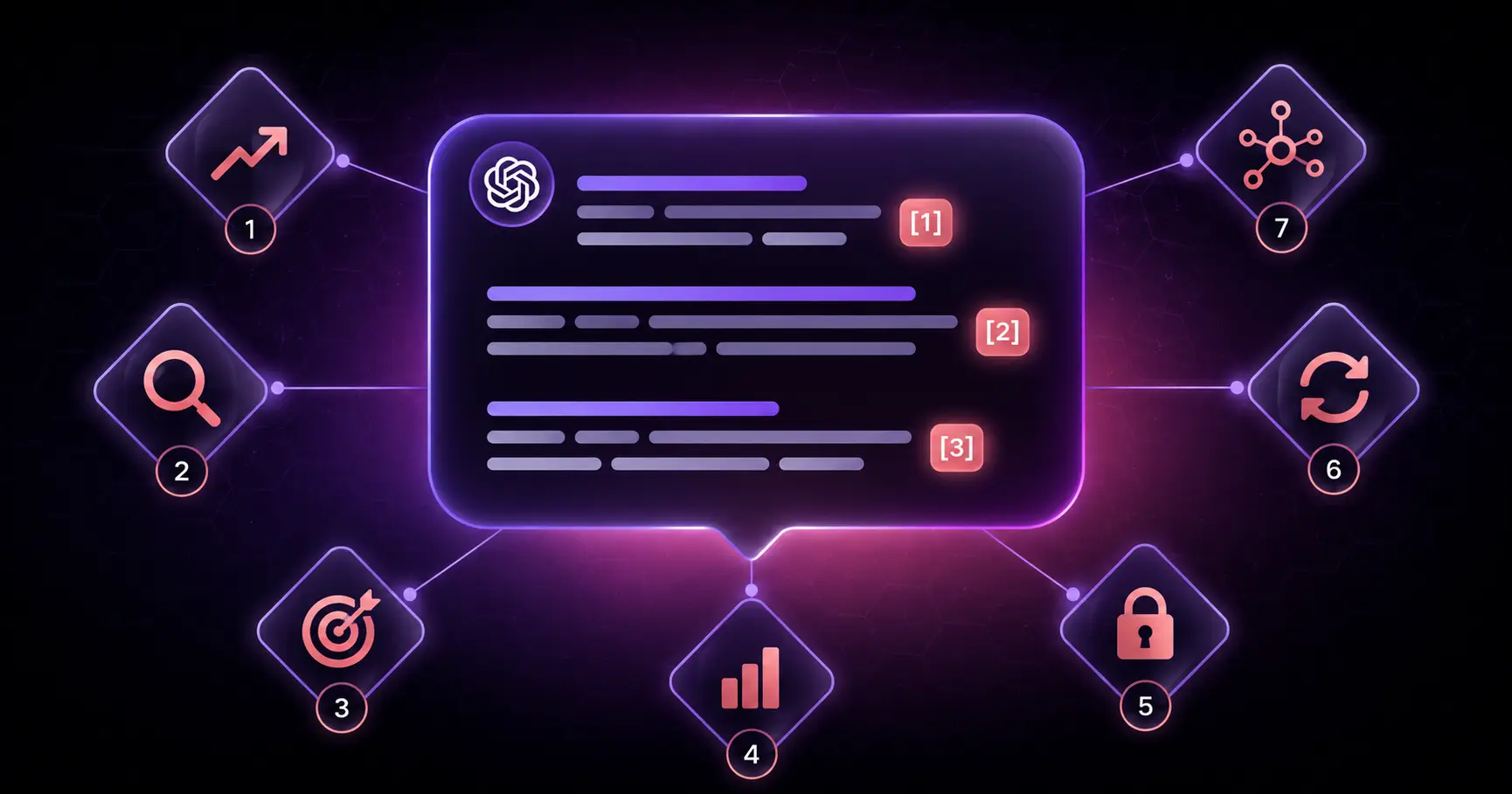
Getting cited consistently across Google AI Overviews, ChatGPT Search, and Perplexity requires a unified strategy that addresses the shared and platform-specific ranking factors we outlined above. These seven strategies are the exact methods we use with RankBrain clients to build cross-platform AI search visibility — and they work for businesses of any size and industry.
1. Restructure Every Key Page for AI Extraction
The single highest-impact change you can make is restructuring your content so that AI systems can easily extract and cite it. This means every H2 section on your site should open with a 1-2 sentence direct answer to the question implied by the heading, followed by supporting detail. AI systems are looking for concise, authoritative statements they can pull into their responses, and they will skip over pages that bury the answer deep in a paragraph.
Beyond opening sentences, you should incorporate comparison tables wherever you are comparing options, features, or approaches. Tables are the number one content format extracted by Google AI Overviews, and they perform well on Perplexity as well. Use numbered lists for processes and step-by-step instructions. Use bulleted lists for feature sets, criteria, and unordered collections. Use bold text to highlight key terms and proper nouns that AI systems use for entity recognition.
This restructuring exercise does not require you to write new content — it requires you to reformat your existing content for AI readability. Most businesses can noticeably improve their AI citation rate just by reformatting their top 20 pages. Our core SEO services include a full content restructuring audit as part of every engagement.
2. Implement Comprehensive Schema Markup
Schema markup is the highest-impact technical signal for Google AI Overviews, and it provides secondary benefits for Bing (and by extension, ChatGPT Search). At minimum, every page on your site should have Article or WebPage schema with proper author, datePublished, and dateModified fields. Beyond that, implement FAQ schema on pages with question-and-answer content, HowTo schema on tutorial and process pages, Product and Review schema on commercial pages, and Organization schema on your about and homepage.
The most commonly missed schema opportunity is FAQ schema. When you add FAQ schema to a page that answers common questions in your industry, you are directly signaling to Google that this page contains structured answers to specific questions — and that is exactly what AI Overviews are looking for. We have seen FAQ schema implementation alone increase AI Overview citation rates by 25-35% for pages that already had strong organic rankings.
3. Build Brand Entity Authority Across the Web
ChatGPT Search, in particular, relies heavily on brand entity recognition when deciding which brands to mention and recommend. If your brand does not have a strong, consistent presence across multiple authoritative sources, ChatGPT's model will not have enough entity data to confidently cite you, regardless of how well-optimized your own website is.
Brand entity building requires a multi-channel approach:
- Wikipedia and Wikidata — if your brand is notable enough for a Wikipedia article, this is one of the strongest entity signals you can create. If not, ensure your brand is at least referenced in relevant Wikipedia articles about your industry.
- Industry publications and media — guest articles, interviews, and mentions in respected industry publications create entity association signals that all three AI platforms recognize.
- Consistent NAP data — your business name, address, and phone number should be identical across Google Business Profile, Bing Places, LinkedIn, Crunchbase, and all industry directories.
- Review platforms — active presence on G2, Trustpilot, Clutch, and industry-specific review sites creates entity validation signals that AI systems weight heavily when deciding whether to recommend a brand.
- Social media profiles — verified, active profiles on LinkedIn, X (Twitter), and industry-relevant platforms strengthen entity recognition.
4. Optimize for Bing, Not Just Google
This is the most overlooked strategy in AI search optimization. ChatGPT Search runs on Bing's index, and Perplexity queries Bing alongside other search APIs. If your site is not properly indexed and ranking on Bing, you are invisible to two of the three major AI search platforms.
Bing optimization requires several specific actions: submit your sitemap to Bing Webmaster Tools, verify your site ownership, ensure your Bing crawl budget is not being wasted on low-value pages, and check that Bing is actually indexing your key pages (many sites have indexing gaps on Bing that they are unaware of because they only monitor Google Search Console). Bing also gives more weight to social signals than Google does, so active social media profiles that link to your content can meaningfully improve your Bing rankings and, by extension, your ChatGPT Search visibility.
5. Create Comprehensive, Citation-Dense Long-Form Content
Perplexity's source selection algorithm rewards content depth more than either of the other two platforms. Pages that thoroughly cover a topic from every angle, with specific data points, named sources, and internal citations to supporting evidence, are cited far more often than thin or surface-level content.
The target for AI search optimization is not the 500-word blog post that was standard a few years ago. For topics where you want to earn AI citations, you should be producing 2,500-5,000 word in-depth guides that cover every facet of the topic, include original data or unique analysis where possible, cite external authoritative sources to demonstrate research rigor, and use structured formatting throughout. This approach aligns with the 90-day AI ranking methodology we have documented separately.
The content should also cite its own sources — link to studies, data sets, official documentation, and authoritative external pages. This "cites its sources" signal is weighted heavily by Perplexity and is becoming increasingly important for Google AI Overviews as well.
6. Publish and Update on a Consistent Cadence
Content freshness is a top-3 ranking factor across all three platforms, but it is especially critical for ChatGPT Search, which shows a strong preference for recently published content. Brands that publish high-quality content on a consistent cadence — weekly or biweekly — maintain a persistent advantage in AI search visibility compared to brands that publish sporadically.
Beyond publishing new content, you should establish a systematic update process for your existing content. Every quarter, audit your top-performing pages and update them with new data, new examples, and revised timestamps. Google AI Overviews and Perplexity both check dateModified signals, and a page that was last updated yesterday will outperform an identical page that was last updated a year ago, all other factors being equal.
This does not mean you should artificially update timestamps without changing content — AI platforms are increasingly sophisticated at detecting superficial updates. The update must include substantive changes: new data points, new sections, revised recommendations based on current conditions, or expanded coverage of subtopics that have emerged since the original publication.
7. Build Topic Clusters That Demonstrate Deep Expertise
Google AI Overviews weight topical authority — the depth and breadth of your site's coverage of a specific topic — more heavily than any other factor except content structure. A single great article on AI search optimization will not earn consistent citations if the rest of your site has nothing else about AI search. But a site with 15-20 interconnected articles covering every dimension of AI search optimization — strategy, technical implementation, platform-specific tactics, case studies, tool reviews — sends an unmistakable signal of topical authority.
The cluster approach also benefits Perplexity and ChatGPT Search, because it creates multiple entry points for citation. When a user asks a broad question, AI systems may cite your pillar page. When they ask a narrow follow-up, the AI may cite one of your supporting articles. The more coverage you have, the more citation surface area you create.
Building effective topic clusters requires a structured approach: identify your core topics, map the subtopics and questions within each, create a pillar page for each core topic, publish supporting articles for each subtopic, and interlink them all with descriptive anchor text. This is a foundational component of our generative engine optimization methodology, and it is the strategy that delivers the most durable AI search visibility over time.


 Shopify SEO