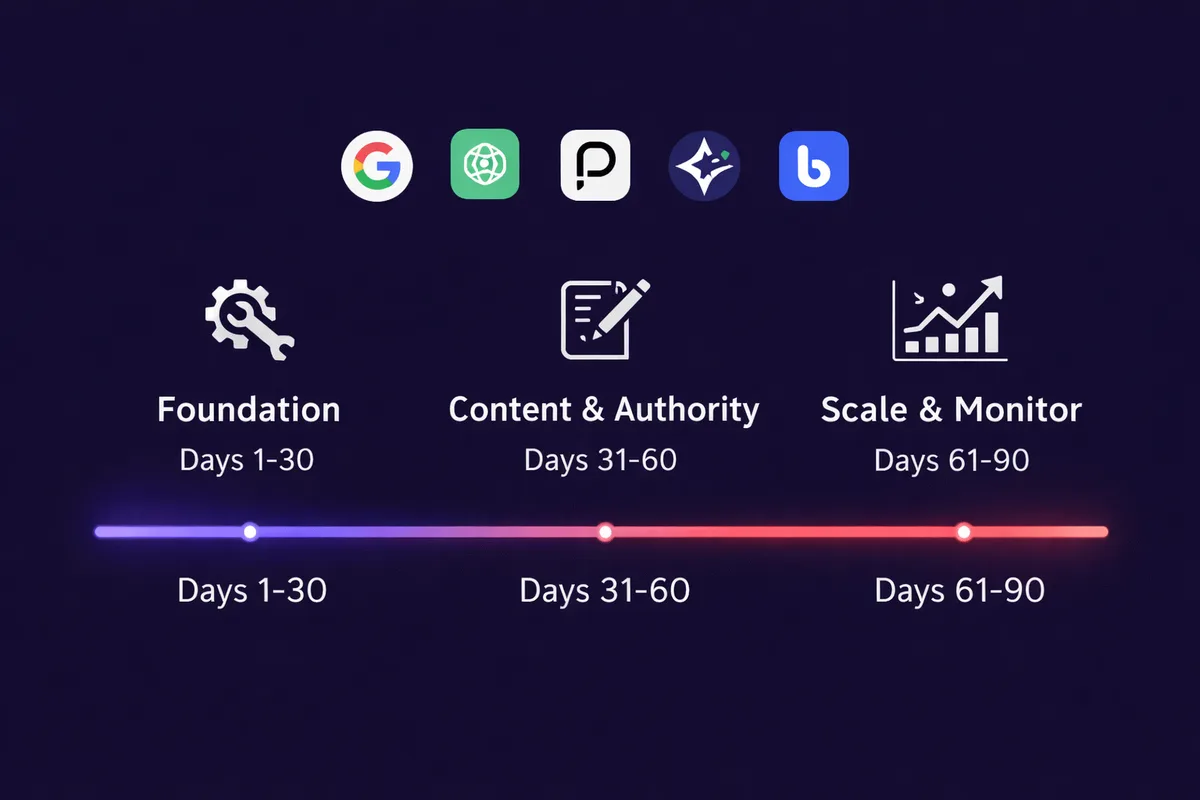
The first 30 days are about getting your house in order. You can't rank on AI search if your technical foundation is broken, your content lacks authority signals, or AI systems can't parse your pages. Here's exactly what to do.
Week 1: E-E-A-T Audit and Content Gap Analysis
Start by auditing your existing content through the lens of Experience, Expertise, Authority, and Trust. For every key page on your site, ask:
- Does this page demonstrate first-hand experience with the topic?
- Is the author clearly identified with relevant credentials?
- Are claims backed by specific data, examples, or external sources?
- Does the page link to authoritative references?
Then run a content gap analysis against the top 3 competitors in your space. Identify the questions your audience is asking on AI platforms that your site doesn't answer yet. Tools like Semrush, Ahrefs, and AlsoAsked can surface these gaps — but the fastest method is simply asking ChatGPT and Perplexity the questions your customers ask, and seeing who gets cited.
Week 2: Schema Markup and Technical SEO Baseline
AI search engines rely heavily on structured data to understand your content. During week 2, implement these schema types across your site:
- Organization schema — establishes your brand entity
- Article/BlogPosting schema — on every blog post and guide
- FAQ schema — on pages with question-answer content
- HowTo schema — on tutorial and process content
- Author/Person schema — links content to real people with expertise
- LocalBusiness schema — if you serve specific regions
Simultaneously, ensure your technical SEO baseline meets AI crawling requirements: Core Web Vitals passing (LCP under 2.5s, INP under 200ms, CLS below 0.1), clean site architecture, proper canonical tags, and XML sitemaps submitted to both Google Search Console and Bing Webmaster Tools.
Week 3: Brand Entity Building
AI models decide whether to cite your brand based on how frequently and consistently it appears across the web. This week, focus on strengthening your brand entity:
- Google Knowledge Panel — claim it via Google's verification process if you haven't already
- Wikipedia and Wikidata — if your brand qualifies, a Wikipedia mention is one of the strongest entity signals
- Consistent brand mentions — ensure your company name, URL, and key leadership appear identically across LinkedIn, Crunchbase, industry directories, and press mentions
- Author pages — create detailed author bio pages on your site linking to each author's published work, social profiles, and credentials
This isn't about vanity metrics. AI systems use these cross-web signals to determine whether your brand is a trustworthy source worth citing. Without a strong entity presence, even great content gets overlooked.
Week 4: Content Restructuring for AI Extraction
Take your top 10 highest-traffic pages and restructure them for AI consumption:
- Answer-first format — every H2 section should open with a 1–2 sentence direct answer before elaborating
- Definition boxes — include clear "What is X?" definitions that AI can extract verbatim
- Comparison tables — AI platforms love structured comparison data they can cite directly
- Bullet point summaries — end each major section with a scannable key takeaways list
- Internal links — link from these pages to your other relevant content, building topical clusters
By day 30, your site should have clean technical SEO, proper schema on all key pages, a strengthened brand entity, and your top content restructured for AI extraction.


 Shopify SEO