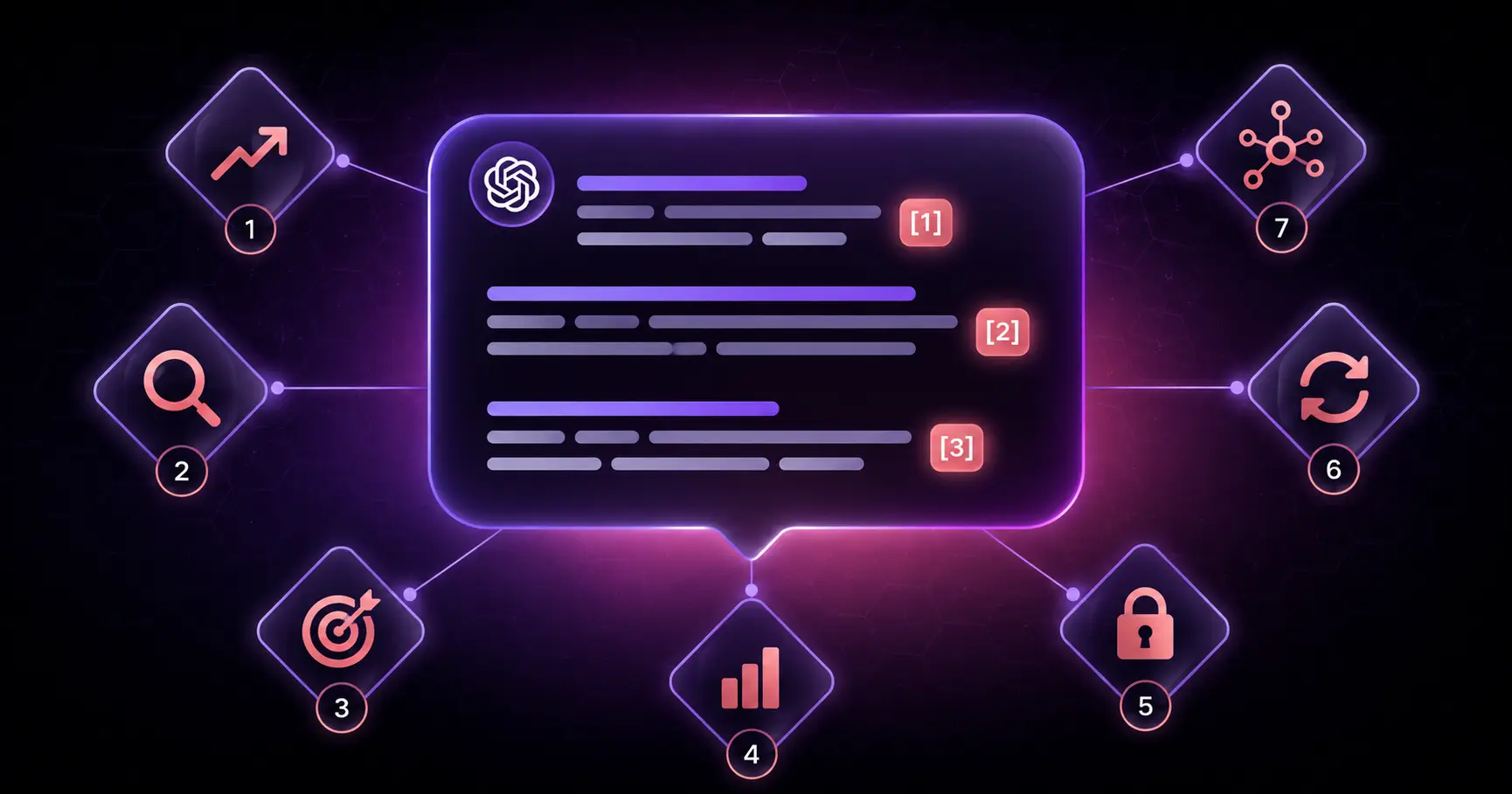
Every major AI platform has rolled out some form of agentic search, though the depth of autonomy, browsing behavior, and citation style vary quite a bit. Knowing how each platform works is important if you want your content showing up across the whole agentic search ecosystem.
ChatGPT with Browsing (OpenAI)
ChatGPT's browsing mode — available to Plus, Team, and Enterprise subscribers — is the most widely used agentic search tool as of 2026. When someone asks a question that needs current information, ChatGPT kicks off its browsing agent, which searches via Bing, opens and reads multiple pages, and puts together an answer with clickable citations. OpenAI reported in January 2026 that ChatGPT processes over 1 billion browsing-enabled queries per week. The agent is especially thorough for comparison queries, product research, and multi-step questions. It tends to favor well-structured pages with clear headings, avoids sites that block its crawler (GPTBot), and leans toward sources that give direct, thorough answers rather than thin content spread across too many pages.
Perplexity Pro
Perplexity has positioned itself as the "answer engine," and its Pro tier is probably the purest implementation of agentic search you'll find right now. Perplexity Pro's agent can run multi-step research plans, browse dozens of sources per query, and produce structured reports with numbered citations. What sets it apart is transparency — users can see exactly which sources were consulted and how the answer was built. For content creators, this is useful because it reveals what Perplexity's agent looks for: recent publication dates, authoritative domains, factual specificity, and original data or analysis. Perplexity's PerplexityBot crawler is aggressive, indexing new content within hours of publication. Making sure your site is crawlable by PerplexityBot and packed with high-quality, current content is a baseline requirement. Our Rank on AI service includes specific Perplexity optimization as a core deliverable.
Claude with Tool Use (Anthropic)
Anthropic's Claude approaches agentic search differently through its tool-use and computer-use capabilities. Instead of a dedicated browsing mode, Claude can be equipped with tools that let it search the web, read pages, interact with APIs, and even navigate websites visually using screen-based computer use. This makes Claude's agentic search particularly strong for complex, multi-system research — for example, comparing pricing across three SaaS platforms by actually visiting their pricing pages and reading current rates. Claude's focus on accuracy, and its habit of flagging uncertainty when sources disagree, means it strongly favors content that's precise, well-cited, and recently updated.
Google Gemini Deep Research
Google's Gemini Deep Research, launched in late 2025, is Google's play in the full agentic search space. When someone activates Deep Research mode, Gemini maps out a detailed research plan, browses multiple web sources using Google's search infrastructure, and generates a multi-page report with citations. Because Deep Research taps into Google's own search index, it has access to the broadest pool of web content of any agentic system. Pages that already rank well in Google's traditional index have a built-in advantage here. That said, Deep Research also applies extra quality filters — it deprioritizes thin, ad-heavy, or poorly structured pages even if they hold strong traditional rankings. Google has stated that Deep Research uses "quality rater guidelines" principles in its source selection, which means E-E-A-T signals (Experience, Expertise, Authoritativeness, Trustworthiness) carry a lot of weight.
OpenAI Operator
OpenAI Operator is the most advanced form of agentic search out there, blurring the line between search and action. Operator is an autonomous browser agent that doesn't just search and read — it can interact with websites, fill out forms, click buttons, walk through multi-page workflows, and even complete purchases. For e-commerce and subscription businesses, this is a big shift: the "searcher" visiting your site might not be a human at all, but an AI agent acting on someone's behalf. That means your website's usability, navigation, and form accessibility need to work flawlessly for an automated agent. Sites with aggressive pop-ups, CAPTCHAs, or confusing navigation will lose agentic traffic. Clean semantic HTML, logical navigation, and accessible forms? Those win. Operator is currently available to ChatGPT Pro subscribers, with broader rollout expected throughout 2026.
Across all five platforms, one thread runs through everything: agentic search agents reward content that's thorough, well-structured, recently updated, factually accurate, and technically accessible. Optimizing for one platform effectively optimizes for all of them because the underlying quality signals are remarkably consistent. A unified generative engine optimization strategy is the most efficient path to visibility across the entire ecosystem.


 Shopify SEO