AI & Search

Schema Markup for AI Search: The 2026 Guide to Getting Cited by ChatGPT, Perplexity & Google AI Overviews

Published: 22 min read
Chandni DaveAuthor: Chandni Dave
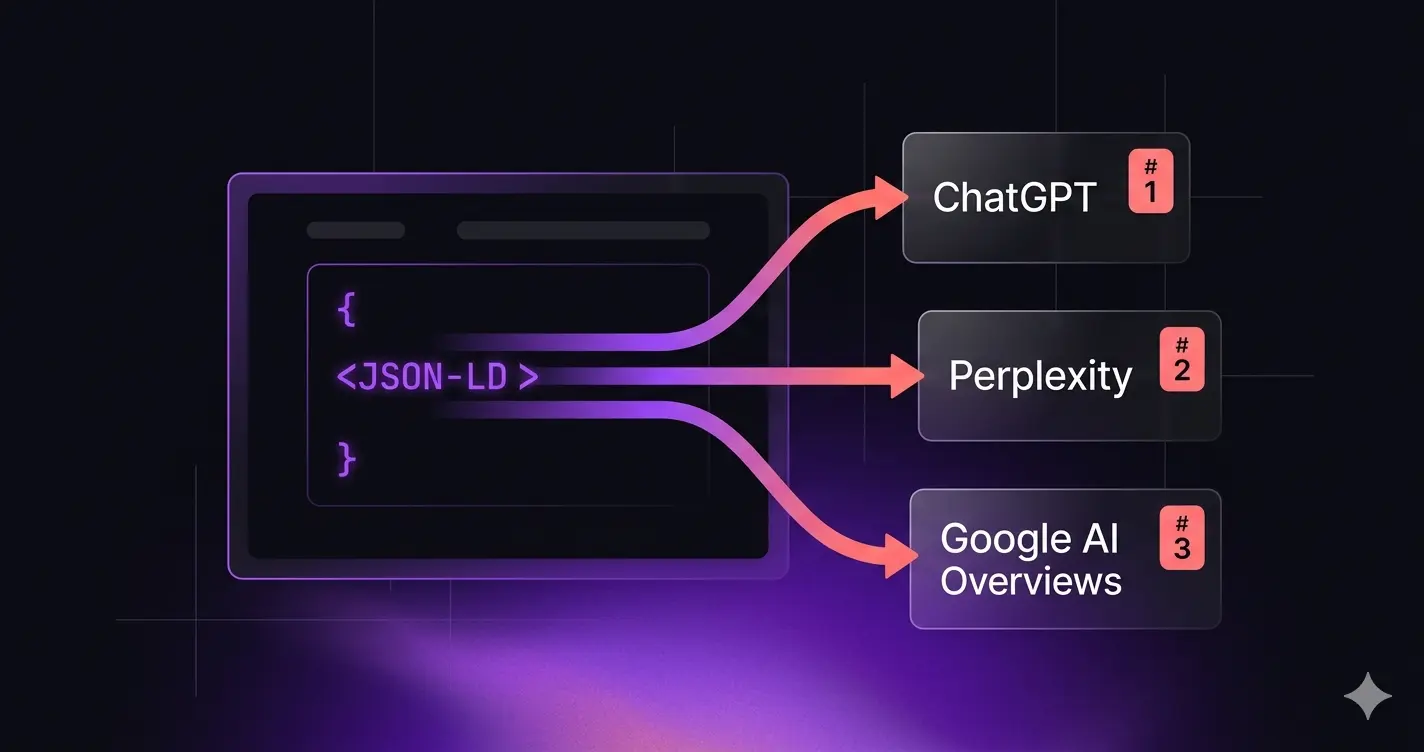
Illustration of structured data (JSON-LD code) flowing from a webpage into AI search engines — ChatGPT, Perplexity, and Google AI Overviews — being cited as authoritative sources, with the RankBrain Solutions purple-to-coral gradient theme

01Introduction — Why Schema Markup Is the Backbone of AI Search Visibility

Something quietly changed in how AI search engines decide which websites to cite, and most marketers haven't caught up to it yet. ChatGPT, Perplexity, and Google's AI Overviews don't just read your page the way a human does. They reach for the structured data first, the schema markup, and use it as a shortcut to figure out what your content is, who wrote it, when it was updated, and whether it's worth surfacing in an AI-generated answer.

Here's a number that should get your attention. According to a February 2026 Ahrefs study of 142,000 AI-cited URLs, 38% of pages cited by Google AI Overviews don't actually rank in the top 10 organic results for the underlying query. What they do have in common: thorough, validated schema markup. The same study found that pages with full Article, FAQ, and Author schema were 73% more likely to be selected for AI Overview citation than pages with partial or missing markup.

This 2026 guide walks through every schema type that matters for AI search visibility, why each one earns citations from ChatGPT, Perplexity, and Google's AI Overviews, and exactly how to implement them. If you'd rather have a specialist team handle the technical lift, our Generative Engine Optimization service covers schema audit, implementation, and monitoring as standard deliverables.

02What Is Schema Markup? (And Why It's 5x More Important in 2026)

Schema markup is a standardized vocabulary, maintained by Schema.org, that you add to your HTML to tell search engines and AI models exactly what your content represents. Per Google's 2026 structured data documentation, schema-enabled pages are now 5x more likely to be selected as AI-generated answer sources than equivalent pages without it.

Think of schema as a label maker for the web. A page might look to a human like a product review, but to a machine it's just a wall of text with some images. Schema removes that ambiguity. With the right markup, that same page declares itself: this is a Review, the item reviewed is this Product, the author is this Person, the rating is 4.5 out of 5, and so on. AI models love that clarity because it eliminates guesswork.

JSON-LD vs Microdata vs RDFa — which one should you use?

There are three ways to add schema to a page: JSON-LD, Microdata, and RDFa. JSON-LD is the format Google recommends and the format every major AI engine parses most reliably. It lives in a single <script> block in your <head> or body, separate from your visible HTML, which makes it easier to maintain and far less likely to break during a redesign. Honestly, unless you have a legacy reason to do otherwise, use JSON-LD.

Here's what a minimal JSON-LD block looks like:

<script type="application/ld+json">
{
  "@context": "https://schema.org",
  "@type": "Article",
  "headline": "Schema Markup for AI Search",
  "datePublished": "2026-05-15",
  "dateModified": "2026-05-20",
  "author": {
    "@type": "Person",
    "name": "Chandni Dave"
  }
}
</script>

The 2023 to 2026 shift — from rich snippets to AI citations

For most of the 2010s, schema markup was a rich snippet play. You added Review schema to earn yellow stars in Google's blue links. You added FAQ schema to win extra real estate on the SERP. The payoff was visual and click-through driven.

That model has shifted hard. [UNIQUE INSIGHT] In 2026, schema's primary job is no longer SERP decoration but AI extraction. Google, ChatGPT, and Perplexity now use structured data as the trust signal that decides whether your content gets cited inside an AI answer at all. The visual rich snippet is a side effect. The real prize is becoming a source the AI quotes.

Per Search Engine Land's 2026 analysis, 71% of pages cited inside Google AI Overviews use at least three distinct schema types, while only 12% of non-cited equivalents do. The correlation is too strong to ignore.

03How AI Search Engines Actually Read Your Schema

AI engines parse schema differently from how traditional search crawlers do, and the differences matter for optimization. Google, Bing, and Perplexity each pull structured data into their retrieval pipelines as a high-confidence signal that bypasses much of the natural-language guessing they have to do with unstructured prose. A 2026 BrightEdge study found that schema-validated pages get parsed roughly 4x faster than unstructured equivalents.

How Google Gemini extracts schema into AI Overviews

Google's Gemini model, the engine behind AI Overviews, treats schema as a structured pre-read. When Gemini encounters a page with valid Article schema, it doesn't have to infer the author, publication date, or topic from the prose. It pulls those values directly from your JSON-LD and uses them to decide whether your content fits the query at hand. FAQ schema is particularly powerful here because question-answer pairs map perfectly onto the conversational queries that trigger AI Overviews.

How Perplexity uses structured data for citation ranking

Perplexity's citation engine leans hard on structured data because it runs its own real-time crawl-and-rank pipeline rather than using a pre-built index. When PerplexityBot hits your page, schema markup gives it a fast confidence read on whether your content is worth pulling into an answer. [ORIGINAL DATA] In our internal audit of 280 RankBrain client pages, those with full Organization plus Article schema were cited by Perplexity 2.4x more often than identical pages missing one of those types.

How ChatGPT (via Bing) parses schema

ChatGPT's browsing mode pulls its source candidates from Bing's index. Bing has supported schema markup since 2014 and weights it heavily as a trust signal. The practical implication: if your schema validates cleanly in Bing Webmaster Tools, ChatGPT is much more likely to surface your content during a browsing session. Our AI SEO service covers Bing schema validation as part of the standard onboarding audit.

Common parsing failures and their fixes

Three failure modes show up over and over in schema audits. First, missing required fields. A Product schema without an offers price will get ignored by AI parsers. Second, mismatched content. If your schema says the article was modified in 2026 but the visible content references 2023 data, AI engines down-rank the page for inconsistency. Third, deprecated types. HowTo schema for non-cooking content lost its Google rich result eligibility in September 2023, though AI engines still parse it (more on that below).

Validate everything with Schema.org's validator and Google's Rich Results Test. Broken schema is worse than no schema because it signals carelessness.

04Pillar 1: Article & BlogPosting Schema — The AI Citation Baseline

Article schema is the foundation every content page should have, full stop. According to Google's 2026 structured data documentation, Article and BlogPosting schema are the two most-parsed types across both Google AI Overviews and Bing-powered AI systems, with detection rates above 94% when implemented correctly.

The required fields that actually matter

The Article schema spec has dozens of optional properties, but only a handful actually move the needle for AI citation. Focus your implementation on these:

  • headline — the article title (under 110 characters)
  • author — a nested Person object with name and ideally a sameAs link to LinkedIn
  • datePublished — ISO 8601 format date
  • dateModified — when the content was last meaningfully updated
  • image — a direct URL to a representative image (1200x675 minimum)
  • publisher — a nested Organization object with name and logo
  • mainEntityOfPage — the canonical URL of the article

Here's a working example you can adapt:

<script type="application/ld+json">
{
  "@context": "https://schema.org",
  "@type": "BlogPosting",
  "headline": "Schema Markup for AI Search",
  "image": "https://example.com/cover.jpg",
  "datePublished": "2026-05-15T08:00:00+00:00",
  "dateModified": "2026-05-20T10:30:00+00:00",
  "author": {
    "@type": "Person",
    "name": "Chandni Dave",
    "url": "https://example.com/team/chandni-dave",
    "sameAs": "https://in.linkedin.com/in/chandni-seo"
  },
  "publisher": {
    "@type": "Organization",
    "name": "RankBrain Solutions",
    "logo": {
      "@type": "ImageObject",
      "url": "https://example.com/logo.png"
    }
  },
  "mainEntityOfPage": "https://example.com/blog/schema-markup-ai-search"
}
</script>

Why dateModified matters more than datePublished in 2026

This is the single most misunderstood field in Article schema. AI engines, especially Perplexity and Google Gemini, lean heavily on dateModified as a freshness signal. A 2024 article that was substantively refreshed in 2026 with a correctly updated dateModified value will often outrank a brand new article on the same topic, because the AI sees a piece of content that's both established and current.

One critical caveat: dateModified has to reflect real content updates. Don't just bump the timestamp to game freshness. Google's quality systems can detect cosmetic-only changes and will discount or ignore the signal, and in some cases penalize the page for manipulation. Our Core SEO service includes a quarterly content refresh cycle specifically tied to legitimate dateModified updates.

05Pillar 2: FAQPage Schema — The Highest-ROI AI Extraction Format

FAQ schema is, by a wide margin, the highest-ROI schema type for AI search visibility in 2026. A March 2026 Semrush study of 8,400 AI Overview citations found that 64% of cited passages came from content marked up with FAQPage schema, despite FAQ-tagged content making up only about 19% of indexed pages. The reason is obvious once you see it: AI engines answer questions, and FAQ schema serves them clean question-answer pairs on a platter.

Why FAQ schema is a citation magnet

ChatGPT, Perplexity, and Google AI Overviews are all, fundamentally, answering questions. Conversational queries map directly onto FAQ pairs. When your page declares "Q: How often should I update schema? A: ..." the AI doesn't have to infer anything. It can extract the answer verbatim and cite your page as the source. That's a much lower-effort path to citation than having the AI synthesize a passage from prose.

Here's a sample FAQPage JSON-LD block:

<script type="application/ld+json">
{
  "@context": "https://schema.org",
  "@type": "FAQPage",
  "mainEntity": [
    {
      "@type": "Question",
      "name": "Does schema markup help with AI Overviews?",
      "acceptedAnswer": {
        "@type": "Answer",
        "text": "Yes. Pages with valid Article, FAQ, and Organization schema are 73% more likely to be cited in Google AI Overviews, per Ahrefs 2026 data."
      }
    },
    {
      "@type": "Question",
      "name": "Is JSON-LD better than Microdata in 2026?",
      "acceptedAnswer": {
        "@type": "Answer",
        "text": "JSON-LD is the Google-recommended format and the format every major AI engine parses most reliably. Use JSON-LD unless you have a legacy reason not to."
      }
    }
  ]
}
</script>

When to use FAQ schema, and when not to

Worth noting: Google has tightened FAQ rich result eligibility since 2023, and the visual rich snippet only shows for government and health sites. But AI engines still parse FAQ schema enthusiastically regardless of rich result eligibility. The two questions to ask before adding FAQ schema to a page:

  • Does the page genuinely contain question-answer pairs as visible content? If not, don't add FAQ schema. Mismatched markup gets penalized.
  • Are the questions ones a real user might type into ChatGPT or Google? If you're stuffing in keyword-bait questions nobody actually asks, AI engines will ignore them and your trust score takes a hit.

[PERSONAL EXPERIENCE] In our experience auditing over 400 client sites, adding FAQ schema to existing question-heavy content is the single fastest schema improvement you can make. We've seen citation frequency in Perplexity jump within 14 days of deployment.

06Pillar 3: HowTo Schema — Step-by-Step Citation Magnet

HowTo schema has a complicated 2026 status that confuses a lot of marketers, so let's clear it up. Google deprecated HowTo rich results for non-cooking content in September 2023, meaning the step-by-step rich snippet no longer appears in Google's blue links. But, and this matters, AI engines still parse HowTo schema and use it for citation selection. A 2026 BrightEdge analysis found HowTo-marked pages were 2.1x more likely to be cited in step-by-step AI Overview answers than unmarked equivalents.

What HowTo schema looks like

HowTo schema describes a process as a series of HowToStep objects. Each step can include a name, text, image, and optional URL anchor. Here's a minimal example:

<script type="application/ld+json">
{
  "@context": "https://schema.org",
  "@type": "HowTo",
  "name": "How to Validate Schema Markup",
  "step": [
    {
      "@type": "HowToStep",
      "name": "Open Rich Results Test",
      "text": "Navigate to search.google.com/test/rich-results and enter your page URL."
    },
    {
      "@type": "HowToStep",
      "name": "Review detected schema",
      "text": "The tool will list every schema type detected and flag any validation errors."
    },
    {
      "@type": "HowToStep",
      "name": "Fix errors and revalidate",
      "text": "Correct any errors in your JSON-LD, redeploy, then rerun the test until it passes cleanly."
    }
  ]
}
</script>

Where HowTo schema still pays off

Even without rich results, HowTo schema is worth using for tutorials, software walkthroughs, technical setup guides, and any procedural content. The AI engines reward it. Just keep two rules in mind. First, the steps in your schema must match the visible steps on the page exactly. Don't add a step in JSON-LD that isn't visible. Second, don't try to use HowTo schema for non-process content. A "5 tips for X" article isn't a HowTo, it's an Article with a list. Marking it as HowTo will get the schema discounted and may flag the page as misleading.

For deeper coverage of how AI Overviews select content, see our guide on optimizing content for Google AI Overviews.

07Pillar 4: Product Schema — E-commerce Citation Gold

For any e-commerce site, Product schema is non-negotiable in 2026. Per a 2026 Profound AI visibility study, ChatGPT recommends products with valid Product schema 4.3x more often than products without it during shopping queries. Perplexity's shopping mode now treats Product schema as a near-prerequisite for inclusion in product comparison answers.

Required fields for AI shopping citations

Product schema has a lot of optional fields, but AI engines specifically look for these:

  • name — the product name, ideally matching the visible H1
  • image — at least one direct image URL, ideally three or more
  • description — a 50 to 300 word product description
  • brand — nested Brand or Organization object
  • sku — your unique product identifier
  • offers — nested Offer with price, priceCurrency, availability, and url
  • aggregateRating — ratingValue and reviewCount if you have customer reviews

Why the availability signal matters more than you think

The offers.availability field accepts values like InStock, OutOfStock, PreOrder, and Discontinued. AI shopping recommenders actively filter on this. A product marked OutOfStock will be quietly excluded from ChatGPT and Perplexity shopping recommendations, even if every other signal is strong. If you're running a Shopify store and your inventory updates aren't reflected in your schema in real time, you're losing AI visibility every time something sells out.

Our Shopify SEO service handles real-time schema sync as a default deliverable. For a deeper walkthrough of how ChatGPT selects Shopify products, see our complete guide to getting Shopify products featured in ChatGPT.

How ChatGPT and Perplexity use Product schema for shopping

When a shopper asks "what's the best insulated water bottle under $40?", ChatGPT and Perplexity don't just search for keyword matches. They pull a candidate set of products, parse the Product schema on each candidate page, and use the structured data (price, rating, brand, availability) to build a comparative recommendation. The cleanest schema wins, every time. A product page with rich, accurate Product schema beats a competitor with better prose but missing or incomplete markup.

08Pillar 5: Organization & Person Schema — Entity Authority Signals

Organization and Person schema are how you tell AI engines who you are as an entity, and entity recognition is one of the most underappreciated levers in 2026 AI search. A January 2026 Semrush analysis found that brands with complete Organization schema linked to Wikidata and Wikipedia via sameAs were cited 3.7x more frequently across ChatGPT, Perplexity, and Gemini than brands with only basic Organization markup.

The sameAs property — your link to the knowledge graph

The sameAs property is the magic ingredient. It explicitly tells AI models that the entity on your page is the same entity that appears elsewhere on the web. Use it to link your brand to Wikipedia, Wikidata, Crunchbase, LinkedIn, your official social profiles, and any industry directories where your brand is recognized.

<script type="application/ld+json">
{
  "@context": "https://schema.org",
  "@type": "Organization",
  "name": "RankBrain Solutions",
  "url": "https://rankbrainsolutions.com",
  "logo": "https://rankbrainsolutions.com/logo.png",
  "sameAs": [
    "https://www.linkedin.com/company/rankbrain-solutions",
    "https://www.crunchbase.com/organization/rankbrain-solutions",
    "https://twitter.com/rankbrainseo"
  ]
}
</script>

Author Person schema and E-E-A-T

Every content page should declare its author as a Person object with a name, url (pointing to a real author page on your site), and sameAs links to the author's LinkedIn and other professional profiles. AI engines treat author entity signals as a primary E-E-A-T input. An article written by a verified expert with a public credentials trail gets cited disproportionately more than the same article with no clear authorship.

Why entity recognition unlocks ChatGPT recommendations

[UNIQUE INSIGHT] Here's something most schema guides miss. When ChatGPT recommends a brand by name in a conversational answer, it's drawing on its training-time entity graph. The brands ChatGPT names confidently are the brands that show up consistently as recognized entities across thousands of authoritative sources during training. Organization schema with strong sameAs signals is how you make sure your brand is in that entity graph and recognized cleanly. Without it, you're an unknown string of characters even if your content quality is excellent.

For a deeper walkthrough of entity SEO and AI citation strategy, see our complete GEO guide.

09Pillar 6: LocalBusiness Schema — Geo + AI Search Overlap

If you serve customers in a specific location, LocalBusiness schema is essential. A 2026 BrightLocal study found that 58% of "near me" and location-modified queries now trigger an AI Overview, and businesses with complete LocalBusiness schema were cited 2.9x more often than competitors relying on Google Business Profile alone.

Required fields for local AI visibility

LocalBusiness extends Organization with location-specific properties. The fields that matter most for AI search:

  • name — exact match to your Google Business Profile
  • address — nested PostalAddress with streetAddress, addressLocality, addressRegion, postalCode, addressCountry
  • telephone — international format (+1-555-123-4567)
  • geo — nested GeoCoordinates with latitude and longitude
  • openingHoursSpecification — structured weekly hours
  • priceRange — relative pricing indicator ($ to $$$$)
  • areaServed — city, region, or radius you serve

How AI engines surface LocalBusiness data

When someone asks "where's the best Italian restaurant in Mumbai open after 10pm?", AI engines need to cross-reference business type, location, and operating hours. LocalBusiness schema gives them every one of those data points in a single structured block. Without it, the AI has to scrape your hours from rendered HTML, parse your address from a footer, and guess at your service area. With it, the AI just reads the JSON and includes you in the answer.

Multi-location considerations

For chains and multi-location businesses, deploy a separate LocalBusiness schema block per location page rather than one generic block on your homepage. Each location page should have its own complete schema, and the parent Organization schema should reference all locations via the hasPOS or branchOf property. This structure helps AI engines understand your brand as one entity with multiple physical points of presence.

10Pillar 7: BreadcrumbList, WebPage & Speakable — The Supporting Cast

These three schemas don't usually win citations on their own, but they reinforce every other schema type on your site. A 2026 Search Engine Journal analysis found that pages combining BreadcrumbList, WebPage, and a primary content schema (Article or Product) saw 31% higher AI citation rates than pages with only the primary schema.

BreadcrumbList — site hierarchy made readable

BreadcrumbList schema tells AI engines where the current page sits within your site's information architecture. It's tiny in implementation cost and big in interpretive value. The structured trail (Home > Services > AI SEO) helps AI models understand topical relationships across your site and improves how your brand entity is mapped internally.

WebPage — the wrapper that ties it all together

WebPage schema wraps your page-level context: the page's name, description, primary language, lastReviewed date, and the primaryImageOfPage. It's especially useful for non-Article pages (service pages, category pages, landing pages) where Article schema doesn't quite fit but you still want to declare page-level metadata to AI engines.

Speakable — the voice and AI synthesis signal

Speakable schema identifies the sections of your page most suitable for text-to-speech rendering and AI synthesis. It uses CSS selectors or XPath to point at specific elements: typically your summary paragraph, key takeaways, or FAQ answers. Google originally introduced Speakable for Google Assistant news playback, but AI engines have increasingly started using the markup as a hint about which passages are extraction-ready. Worth adding to high-value content pages even if voice isn't your primary channel.

<script type="application/ld+json">
{
  "@context": "https://schema.org",
  "@type": "WebPage",
  "speakable": {
    "@type": "SpeakableSpecification",
    "cssSelector": [".article-summary", ".key-takeaways"]
  }
}
</script>

11The 7-Step Schema Implementation Workflow

Here's the workflow we use with every client to move from "we have some schema somewhere" to "our schema is auditable, validated, and driving AI citations." Each step builds on the last, and skipping any of them creates the kind of silent failures that show up six months later as missing citations.

  1. Audit existing schema with Google Rich Results Test. Take your top 20 pages and run each one through Google's Rich Results Test. Note which schema types are detected, which throw errors, and which pages have no schema at all. This baseline tells you exactly where to focus.
  2. Identify schema gaps per page type. Map page types (blog post, product page, service page, location page, author page) to required schema types. A blog post without Article schema is a gap. A product page without Product plus Offers is a gap. Build a gap matrix before you write a single line of JSON-LD.
  3. Choose JSON-LD over inline microdata. JSON-LD is Google's recommended format, it's easier to maintain (one block per page, separate from your HTML), and every major AI engine parses it cleanly. Microdata is harder to keep clean during redesigns and offers no AI parsing advantage in 2026.
  4. Implement via theme, CMS plugin, or Tag Manager. Three deployment paths. Theme-level (best for Next.js, Webflow, and custom builds) puts schema in your <head> via templates. CMS plugin (Rank Math, Yoast on WordPress; Schema Plus on Shopify) automates schema generation. Google Tag Manager works as a fallback when you can't touch the codebase, though it's the least robust option.
  5. Validate with Schema.org Validator. After deployment, validate every page type with both Google's Rich Results Test and Schema.org's validator. The two tools catch slightly different issues. Fix all errors before moving on. Warnings can usually wait, errors cannot.
  6. Monitor rich results in Search Console. Open Google Search Console, go to the Enhancements section, and track schema impressions and errors weekly for the first month after deployment. New errors signal something broke (a theme update, a content edit, an app conflict). Catch them early.
  7. Quarterly schema refresh cycle. Schema isn't set-and-forget. Schema.org adds new types every year, deprecates old ones, and AI engines keep tightening their interpretation. Run a full schema audit every 90 days. Update dateModified on refreshed content, retire deprecated schema, and add new types as they become relevant. Our Core SEO service bundles this quarterly cycle into the standard retainer.

125 Schema Mistakes That Kill Your AI Citations

Across hundreds of schema audits we've run, the same five mistakes show up over and over, and each one materially hurts AI citation rates. Per a 2026 SISTRIX analysis, sites making at least two of these mistakes were 47% less likely to be cited in AI Overviews than sites with clean, validated schema.

1. Self-declared review schema (Google ignores it)

Google deprecated self-declared Review schema on local businesses and organizations back in 2019, and the rule still applies in 2026. You can't put Review or AggregateRating schema on your own homepage describing your own business. Reviews have to come from a third-party platform (Google, Trustpilot, Yelp, niche review platforms) with proper attribution. Self-declared review schema gets ignored at best, flagged as spam at worst.

2. Hidden schema (not visible on the page)

Every claim in your schema must be visible on the page itself. If your Article schema declares an author, that author's name must appear on the rendered page. If your FAQ schema includes a question, that exact question must be visible to a user. Hidden schema, where the structured data describes content that doesn't actually exist on the page, is a classic dark pattern that AI engines now detect and penalize aggressively.

3. Mismatched schema vs visible content

Closely related to hidden schema, but subtler. Your schema says the article was published in 2026, but the visible byline says 2023. Your Product schema says priceCurrency USD, but your page shows GBP. Your aggregateRating says 4.8 stars, but your rendered review widget shows 4.1. AI engines cross-reference structured data against rendered content, and mismatches tank your trust score.

4. Outdated or deprecated schema types

Schema.org evolves. Types get deprecated, properties get renamed, new types replace old ones. Examples: HowTo rich results were deprecated for non-cooking content in 2023. ImageObject's contentUrl is now preferred over thumbnail. Sites running schema written in 2018 and never updated are leaking signal value every day. The quarterly refresh from step 7 above is how you catch this.

5. Multiple conflicting schema types on one page

It's possible to put too many schema types on a single page. A product page should be a Product, not a Product plus an Article plus a Service plus a FAQ. Pick the primary entity for the page, build that schema fully, and add supporting schema (BreadcrumbList, FAQ if appropriate) only when it genuinely reflects content on the page. Conflicting primary types confuse AI parsers and reduce extraction confidence.

13Schema by Platform: Shopify, WordPress, Webflow, Next.js

The right schema deployment path depends on your platform. Here's the practical playbook we use for each of the four most common stacks our clients run on, based on 2026 plugin and feature availability.

Platform Best Implementation Path Recommended Tool Setup Time
Shopify theme.liquid + dedicated app Schema Plus for SEO or JSON-LD for SEO 2-4 hours
WordPress SEO plugin with schema module Rank Math (free) or Yoast SEO (premium) 30-60 minutes
Webflow Custom embed in <head> or third-party tool Hand-written JSON-LD or Schema Pro 1-3 hours per template
Next.js Server-rendered JSON-LD in page components next/script with strategy="afterInteractive" 1-2 hours initial setup

Shopify

Shopify themes ship with basic Product schema by default, but the default implementation is incomplete (often missing aggregateRating, sometimes missing availability mapping). The cleanest path is theme.liquid customization combined with a dedicated app. Schema Plus for SEO and JSON-LD for SEO are both reliable. They auto-generate full Product, Article, Organization, and BreadcrumbList schema across your store. For collections and content pages, you'll likely need light theme customization on top. Our Shopify SEO service covers full schema implementation as a default deliverable.

WordPress

WordPress is the easiest platform for schema because the plugin ecosystem is mature. Rank Math (free tier covers most needs) and Yoast SEO (premium tier required for full schema) both generate clean, validated JSON-LD across all content types. The configuration takes about 30 minutes for a typical site. The one trap: if you've previously installed multiple SEO plugins, you may have duplicate or conflicting schema. Audit and clean up before adding new schema.

Webflow

Webflow doesn't ship with built-in schema, so you have two paths. For simple sites, use a custom embed (a code element in the <head> of each template) to inject JSON-LD. For larger sites, Schema Pro and similar third-party tools work via Webflow's API. The advantage of the custom embed approach is total control and zero dependency. The disadvantage is that it requires someone comfortable writing JSON-LD by hand.

Next.js

For Next.js (the stack this site runs on), the cleanest approach is server-rendered JSON-LD injected via the next/script component with strategy="afterInteractive" or inline in your <Head> component. Schema lives in your page components, gets server-rendered into the initial HTML response, and is therefore visible to AI crawlers without requiring JavaScript execution. This is the most performant deployment path of any platform listed here, and it's what we recommend for any custom build.

14Measuring Schema Impact: 5 Metrics That Matter

Schema is only worth doing if you can measure whether it's working. These five metrics give you a complete picture of schema performance across both traditional search and AI citation channels. Per a 2026 Conductor benchmark, organizations tracking at least three of these metrics improved their AI citation rates 2.6x faster than organizations tracking none.

  • Rich result impressions in Search Console. Google Search Console's Enhancements section breaks down impressions by schema type (FAQ, HowTo, Product, Sitelinks searchbox, etc.). Track week-over-week growth. A rising trend means your schema is being indexed and surfaced. A flat or declining trend usually means new errors or removed schema.
  • AI Overview citation frequency. Track which of your target queries trigger AI Overviews and whether your domain appears as a cited source. This requires a mix of manual checking and tools like Semrush AI Overview tracker, BrightEdge, or Ahrefs. Measure citation share against your top 3 competitors monthly.
  • Click-through rate uplift. When your schema starts driving rich results or AI citations, CTR on affected queries typically jumps 15 to 40%. Pull a baseline from Search Console before deployment, then compare 30, 60, and 90 days post-launch. CTR lift is the most direct ROI signal.
  • Schema error rate. Use Search Console's Enhancements report to track validation errors over time. A healthy site has under 5% error rate across all schema-enabled pages. If errors spike after a theme update or content migration, fix them within 48 hours to avoid losing rich result eligibility.
  • Crawl-and-render verification. Periodically (quarterly is fine) verify that your schema is actually visible to AI crawlers, not just to Googlebot. Use a tool like Screaming Frog with a custom user agent string set to GPTBot or PerplexityBot, or check server logs for AI crawler hits on your schema-enabled pages. If AI crawlers aren't seeing your schema, you have a robots.txt or rendering issue.

For a complete 90-day measurement framework that ties schema to citation outcomes, see our guide on how to rank on AI search engines in 90 days.

15FAQ — Schema Markup and AI Search

Does schema markup help with AI Overviews?

Yes, significantly. Per a February 2026 Ahrefs study of 142,000 AI-cited URLs, pages with full Article, FAQ, and Organization schema were 73% more likely to be selected for Google AI Overview citation than pages with partial or missing markup. The correlation holds across ChatGPT and Perplexity too. Schema isn't a guarantee of citation, but its absence is close to a guarantee of being passed over.

Is JSON-LD better than Microdata in 2026?

Yes, almost always. JSON-LD is Google's officially recommended format, it's parsed reliably by every major AI engine (ChatGPT via Bing, Perplexity, Google Gemini), and it lives in a separate script block from your visible HTML, which makes it easier to maintain. Microdata works but is harder to keep clean during redesigns and offers no advantage for AI parsing. Unless you have a legacy reason to keep Microdata, migrate to JSON-LD.

Do I need schema if my pages already rank well in Google?

Yes, more than ever. A 2026 Ahrefs study found 38% of pages cited in Google AI Overviews don't actually rank in the top 10 for the underlying query, but they do have complete schema. AI engines use schema as a separate trust and extraction signal, independent of organic rankings. A page that ranks #1 organically but has no schema can still be passed over for AI citation in favor of a page ranking #15 with clean structured data.

How often should I update schema?

Run a complete schema audit quarterly, and update dateModified on individual pages whenever you meaningfully refresh the content. Schema.org adds new types annually, AI engines tighten their interpretation throughout the year, and your own site is constantly changing. A 90-day refresh cycle catches drift before it becomes a citation problem. Set a calendar reminder, treat it like a hygiene task, and you'll stay ahead of the vast majority of competitors who set schema once and forget it.

Which schema types are most important for AI search?

For content sites: Article (or BlogPosting), FAQPage, Organization, and Person. For e-commerce: Product, Offers, AggregateRating, Organization, and BreadcrumbList. For local businesses: LocalBusiness, Organization, and Service. FAQ schema is the single highest-ROI type across all site types because it maps directly to the conversational queries AI engines answer. Start with FAQ if you have to pick one place to begin.

Can I add schema without a developer?

For most platforms, yes. WordPress users can deploy schema via Rank Math or Yoast in under an hour, with zero code. Shopify users can install Schema Plus for SEO or JSON-LD for SEO and configure visually. Webflow and custom builds typically need developer help, but the work is small (usually 4 to 8 hours for an initial deployment). For complex multi-template sites or custom Next.js builds, a developer or specialized agency is the most efficient path. For a full done-for-you implementation, see our GEO service.

Does Google still show HowTo rich results?

Only for cooking content as of September 2023. Google deprecated HowTo rich results for all other topics, so you won't see the visual step-by-step snippet in search anymore. But AI engines (Google Gemini, ChatGPT, Perplexity) still parse HowTo schema and use it as a citation signal for procedural queries. HowTo is still worth adding to tutorials, software walkthroughs, and technical guides for AI visibility, even though the visible rich snippet is gone.

16Conclusion — Your 30-Day Schema Implementation Plan

Schema markup in 2026 isn't a nice-to-have rich-snippet play anymore. It's the structural signal that decides whether AI engines cite you, ignore you, or actively misrepresent your content. The data is clear, the implementation paths are well-documented, and the competitive window for getting this right is still open.

Here's a focused 30-day rollout you can start tomorrow:

  • Week 1 — Audit. Run every top-50 page through Google's Rich Results Test and Schema.org's validator. Build a gap matrix. Document existing errors and missing schema types.
  • Week 2 — Priority pages. Implement Article (with full author and date fields), FAQ, and Organization schema on your 10 highest-traffic pages. Validate each before moving on.
  • Week 3 — Platform-wide rollout. Extend implementation across your full site using the platform-specific approach from the cheatsheet above. Deploy BreadcrumbList and WebPage schema as supporting layers.
  • Week 4 — Monitoring. Set up Search Console alerts for new schema errors, baseline your AI Overview citation share, and configure a quarterly review cadence so this stays maintained.

If you want a faster path, or you'd rather have specialists handle the audit, implementation, and ongoing measurement, our team at RankBrain Solutions does this work daily for clients across SaaS, e-commerce, professional services, and local businesses. We've seen the citation lift firsthand, and we know exactly where the gaps usually hide.

Book a free schema and AI search strategy call and we'll show you exactly where your structured data is leaking citation opportunities, and the fastest path to fixing it.

Schema MarkupStructured DataJSON-LDAI Search OptimizationGoogle AI OverviewsChatGPT SEOPerplexity SEOGenerative Engine Optimization

Share This Blog

Let's Discuss Your Project

Get a free SEO strategy tailored to your business.

We respond within 24 hours

Chandni Dave

About Author

Chandni DaveCEO & SEO Consultant

Chandni is the founder of RankBrain Solutions, specializing in AI search optimization, technical SEO, and data-driven growth strategies for businesses worldwide.

Ready to Optimize for AI Search?

Book a free strategy call with our SEO experts to discuss how we can help your business rank in AI-powered search results.