AI & Search

Google AI Overviews Are Killing Organic Traffic: How Smart Brands Are Winning SEO in 2026

Published: 18 min read
Chandni DaveAuthor: Chandni Dave
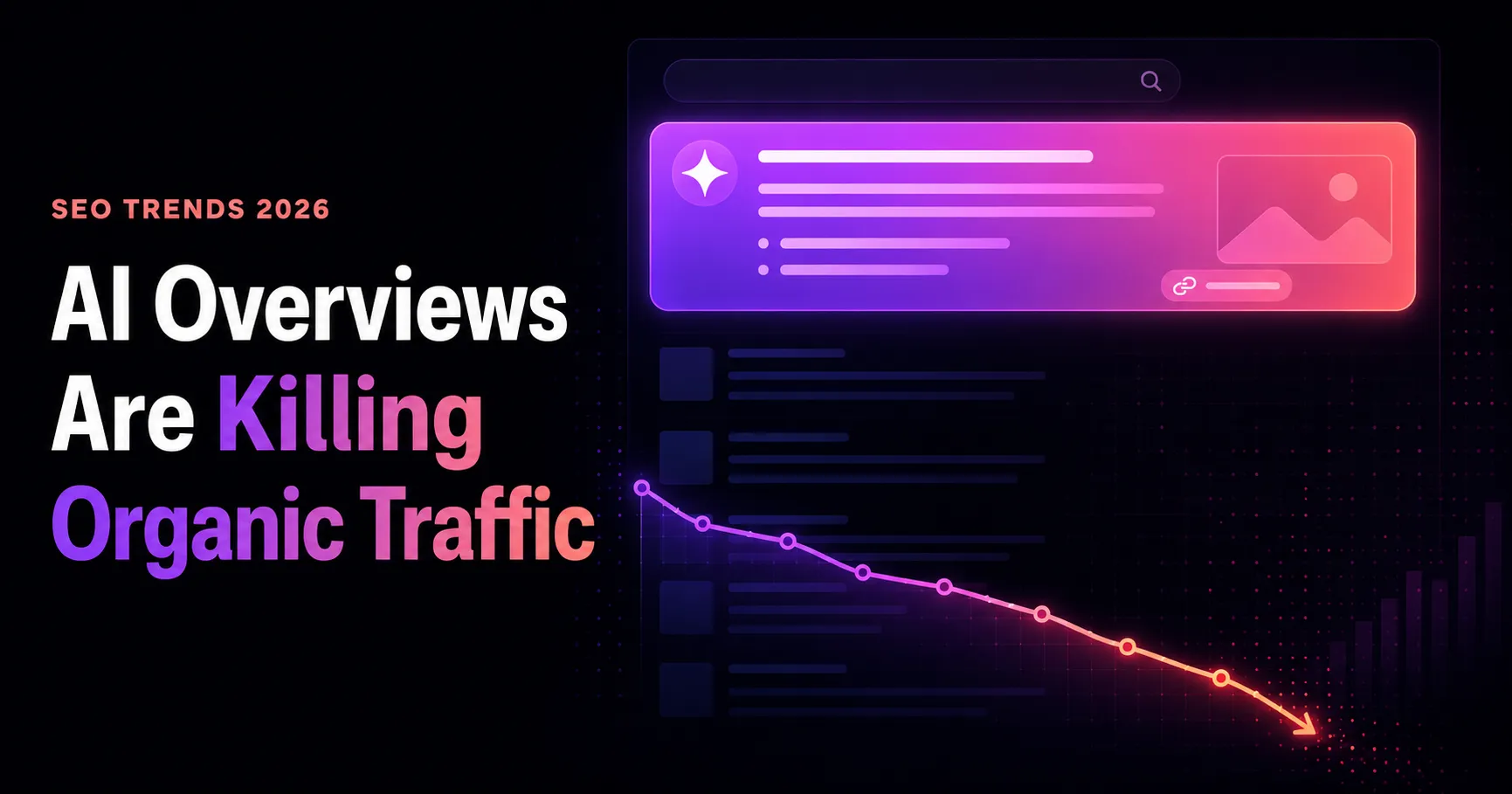
A declining organic-traffic graph beneath a Google AI Overview answer box, illustrating how AI-generated summaries capture clicks before organic results, in the RankBrain Solutions purple-to-coral gradient theme

The Traffic Cliff Nobody Warned You About

A client called us in a panic last quarter. Her rankings hadn't moved. She was still sitting at position one for her biggest money keyword. But her organic traffic had dropped 40% in four months, and she couldn't figure out why. We pulled up the SERP, typed in her keyword, and there it was — a Google AI Overview answering the question completely, before her listing ever appeared on screen.

She was ranking. She just wasn't getting clicked.

This is the quiet crisis hitting thousands of businesses in 2026, and most of them don't see it coming until the revenue dips. The old deal was simple: rank well, get clicks, win customers. That deal is being rewritten in real time.

Here's the number that should stop you cold. When a Google AI Overview appears for a query, the click-through rate for the top organic result drops from 1.62% to 0.61% — a 62% collapse — according to Seer Interactive's September 2025 CTR study of 3,119 terms and 25.1 million impressions. You keep the ranking. You lose most of the traffic.

So is SEO dead? Not even close. But the version of SEO that worked in 2022 is finished, and the brands that understand why are quietly pulling ahead while everyone else refreshes their rank tracker in confusion.

This guide breaks down exactly what's happening, why your traffic is leaking, and the specific playbook smart brands are running to win visibility in AI search — through Generative Engine Optimization (GEO), AI citations, and content built for how machines actually read. Let's get into it.

Key Takeaways

  • When an AI Overview appears, top-result CTR can fall by roughly 62% even when rankings hold steady (Seer Interactive, 2025).
  • In early 2026, around 68% of US Google searches ended without a single click to the open web (SparkToro, 2026).
  • The winning move isn't fighting AI Overviews — it's getting cited by them through GEO, structured data, and answer-first content.

What Are Google AI Overviews, Exactly?

A Google AI Overview is an AI-generated summary that sits at the very top of the search results, answering a query directly using Google's Gemini model and pulling from multiple web sources it cites inline. As of Google's I/O 2025 announcements, AI Overviews had scaled to more than 1.5 billion users across 200 countries (Google, I/O 2025 keynote, May 2025). This is no longer an experiment. It's the default front door to search.

Think of it as Google answering the question itself instead of handing the user a list of ten blue links and stepping aside. The AI reads the top-ranking content, synthesizes an answer, and presents it with a few citation links the user can tap if they want to dig deeper. Most don't.

AI Overviews vs Google AI Mode vs featured snippets

People mix these up constantly, so let's separate them cleanly.

  • Featured snippets are the old model — a single block of text lifted from one page, with a link straight to that page. They sent clicks.
  • AI Overviews are the synthesized, multi-source summaries that now appear above organic results for informational and increasingly commercial queries. They send far fewer clicks.
  • Google AI Mode is the full conversational search experience launched at I/O 2025 — a dedicated tab where the entire results page becomes an AI conversation. No ten blue links at all. You ask follow-ups like you would with ChatGPT.

AI Mode is the direction of travel. AI Overviews are the bridge getting users comfortable with it. And the Gemini app behind much of this already had more than 400 million monthly active users by May 2025 (Google, I/O 2025 keynote). The behavior is being trained into a billion-plus people right now.

Why Google did this

Google didn't blow up its own golden goose for fun. It's responding to a real threat: ChatGPT, Perplexity, and other AI assistants were teaching users they could just ask and get an answer, no clicking required. By October 2025, ChatGPT had reached around 800 million weekly active users, roughly double its February 2025 figure (OpenAI, reported October 2025). Google adapted to keep users inside its ecosystem. The casualty was the click economy publishers and businesses were built on.

For a deeper side-by-side on how each platform behaves, we break it all down in our comparison of Google AI Overviews, ChatGPT Search, and Perplexity.

Why Are Businesses Seeing Traffic Declines?

Businesses are losing organic traffic because AI Overviews answer the user's question on the results page itself, removing the reason to click through — and the data on this is now overwhelming. Ahrefs analyzed 300,000 keywords and found that the presence of an AI Overview reduces clicks to the top-ranking page by 34.5% for informational queries (Ahrefs, "AI Overviews Reduce Clicks by 34.5%", April 2025). That's not a ranking penalty. That's a behavior change.

The pattern repeats across every independent study, with different methodologies pointing the same direction. Here's how the major 2025 analyses stack up.

Study Measured CTR Impact Scope
Ahrefs (Apr 2025) −34.5% clicks to top result 300,000 keywords
Amsive (Apr 2025) −15.49% avg; −27.04% for results outside the top 3 700,000 keywords
Seer Interactive (Sep 2025) CTR fell from 1.62% to 0.61% (~62%) 3,119 terms, 25.1M impressions
Authoritas (2025) −61% organic CTR, −68% paid CTR Reported via Search Engine Land

Notice something in the Amsive numbers. The pages hit hardest aren't the ones ranking first — they're the ones ranking fourth through tenth. Amsive found a 27.04% CTR drop for results outside the top three when an AI Overview was present (Amsive, "Google AI Overviews: New CTR Study", April 2025). If you've been living on page-one-but-not-position-one traffic, that's the floor falling out.

The zero-click reality

Here's the macro picture, and it's stark. In the first four months of 2026, around 68% of US Google searches ended without a single click to the open web — up from roughly 60% in 2024 — based on SparkToro's analysis of Similarweb clickstream data (SparkToro, 2026). Put differently: for every 1,000 searches, only about 276 clicks now reach a website, down from 374 two years earlier.

That's nearly 100 fewer visitors per thousand searches, gone, with no algorithm change you can appeal. The search itself is ending on Google's page.

Our finding from client audits: the businesses panicking hardest are usually the ones with the healthiest-looking rank reports. Their dashboards are green. Their Search Console impressions are flat or even up. But impressions without clicks is the new signature of AI Overview cannibalization, and most legacy reporting setups don't surface it until traffic has already bled out. If your impressions are steady while clicks slide, that gap is the AI Overview.

The Biggest SEO Myths in 2026

The most expensive mistakes we see right now come from clinging to beliefs that were true three years ago and are flatly wrong today. With zero-click searches near 68% in 2026 (SparkToro, 2026), the old playbook doesn't just underperform — it actively wastes budget. Let's kill the myths one by one.

Myth 1: "SEO is dead"

No. Search is bigger than ever — people are running more queries across more surfaces than at any point in history. What died is the assumption that ranking equals traffic. SEO didn't die; it fractured into ranking and citation, and you now need both.

Myth 2: "If I rank #1, I'll get the clicks"

This is the costliest myth in the list. As Seer's data showed, position one can lose 62% of its clicks the moment an AI Overview appears above it. Ranking is necessary but no longer sufficient. The real question is whether you're inside the AI's answer, not just beneath it.

Myth 3: "AI Overviews only affect informational queries"

That was true at launch. It isn't anymore. Industry trackers like BrightEdge have reported AI Overviews appearing on close to half of tracked commercial queries in some verticals heading into 2026, and Google has been folding ads directly into AI Overviews and AI Mode. Commercial intent is squarely in scope now.

Myth 4: "More content will fix it"

Pumping out thin, generic articles is the single fastest way to become invisible to AI systems. Generative engines reward specificity, original data, and clear sourcing — not volume. A pile of me-too posts is exactly what the AI paraphrases without ever citing you.

Myth 5: "GEO is just SEO with a new name"

This one sounds reasonable and gets brands in trouble. The overlap between what Google ranks and what AI engines cite is shockingly small. Optimizing for traditional rankings alone leaves most of your AI citation opportunities untouched. We'll unpack exactly why in the next section.

For the myths specific to AI assistants, our guide on how to rank in ChatGPT goes deeper on why domain authority matters far less than most people assume.

GEO vs Traditional SEO: What Actually Changed

Generative Engine Optimization (GEO) is the practice of optimizing content so AI systems cite it in their generated answers, while traditional SEO optimizes for ranking position in a list of links. The distinction is real and measurable. The foundational research — "GEO: Generative Engine Optimization" by Aggarwal et al. (KDD 2024) — found that GEO tactics can boost a page's visibility in generative engines by up to 40%. Different game, different levers.

Traditional SEO asks: how do I climb the rankings? GEO asks a sharper question: how do I become the source the AI quotes? You can win the second without dominating the first, which is exactly why nimble brands are beating bigger competitors right now.

The research-backed tactics that move AI visibility

The GEO paper tested specific content changes against generative engines, and the results were not subtle. Adding relevant statistics lifted source visibility by around 41%. Adding direct quotations and citing authoritative sources produced some of the largest gains — over 100% visibility improvement for lower-ranked content. The lesson is blunt: AI engines reward content that reads like evidence, not marketing.

Where GEO and SEO diverge

Dimension Traditional SEO Generative Engine Optimization (GEO)
Goal Rank in the top 10 links Get cited inside the AI answer
Primary unit The page The passage / extractable claim
Biggest lever Backlinks & on-page keywords Statistics, citations, brand co-occurrence
Success metric Ranking position & organic clicks Citation frequency & AI referral traffic
Winning content Comprehensive, keyword-rich Specific, sourced, answer-first

This is the heart of it. SEO optimizes the container; GEO optimizes the quotable substance inside it. You still need solid technical SEO and rankings to get retrieved — but retrieval is the entry fee, not the win. The win is the citation.

If you want the full strategic framework, our complete guide to Generative Engine Optimization walks through the entire methodology, and our dedicated GEO service handles implementation end to end.

How AI Search Is Rewiring User Behavior

AI search is changing not just where users find answers, but how they decide — they research longer, ask follow-up questions conversationally, and increasingly arrive at a brand decision before ever visiting a website. Forrester's 2026 research found that the vast majority of B2B buyers now use AI somewhere in their purchasing process, completing much of their research before talking to a vendor (Forrester, 2026 State of Business Buying). The funnel is being compressed inside the chat window.

Think about how you search now versus three years ago. You probably don't open five tabs and compare them anymore. You ask a question, read the synthesized answer, ask a follow-up, and form an opinion — all without leaving the AI. That's the new default, and it has three big implications.

1. The "consideration phase" moves into the AI

Buyers used to compare options by visiting websites. Now the AI does the comparison for them and names a shortlist. If your brand isn't in that shortlist, you're not losing on the merits — you're not even in the room. This is why brand co-occurrence across the web matters so much now.

2. Fewer but higher-intent clicks

Here's the silver lining nobody talks about. The clicks that do come through from AI surfaces tend to convert better, because the user has already done their research and is deeper in the decision. You're getting fewer visitors, but warmer ones. The brands winning in 2026 optimize for citation quality, not raw traffic volume.

3. Conversational, long-tail queries explode

People type full questions now, not keyword fragments. "Best project management tool for a remote team of 15 on a tight budget" instead of "project management software." This rewards content that answers specific, realistic questions directly — and punishes pages built around broad head terms with vague copy. Agentic systems take this even further, and we cover that shift in our breakdown of what agentic search is.

What we're seeing in the field: clients who shifted reporting from "sessions" to "assisted conversions and AI-referred revenue" stopped panicking about the traffic dip almost immediately — because the revenue story was far healthier than the traffic story. The volume was down. The quality was up. If you measure only volume, you'll make the wrong decisions all year.

7 Proven Ways to Get Cited by AI Systems

Getting cited by AI systems comes down to making your content the easiest, most credible source for a machine to quote — and seven tactics consistently move the needle in 2026. These map directly to the research: the original GEO study found that adding statistics, quotations, and authoritative citations lifted AI visibility by 40% or more (Aggarwal et al., KDD 2024). Here's the playbook, in priority order.

1. Lead every section with a direct, quotable answer

AI engines extract the opening sentences of a section far more often than buried text. Start each section by answering the implied question in one or two specific sentences, then support it. If a machine can lift your first sentence and have it stand alone as a correct answer, you've made yourself citable. Bury the answer in paragraph four and you've made yourself invisible.

2. Pack in specific statistics and data points

Replace "many businesses see results" with "68% of US searches ended without a click in 2026, per SparkToro." Specific, sourced numbers are catnip for generative engines — the GEO research showed adding statistics alone lifted visibility around 41%. Vague claims get skipped; verifiable data gets quoted.

3. Cite authoritative sources inside your content

Counterintuitive but proven: linking out to credible sources makes you more citable, not less. The GEO study found citing sources boosted visibility of lower-ranked content by over 100%. AI systems trust content that behaves like research, with its receipts attached.

4. Build brand co-occurrence across the open web

AI models build an entity map of your brand from how often it appears alongside your category across the web — in articles, roundups, Reddit threads, podcast transcripts. Unlinked mentions count. The more consistently your brand co-occurs with your category, the more likely the AI names you. This is the single hardest factor to fake and the most durable to own.

5. Implement complete, validated schema markup

Structured data tells machines what your content is, who wrote it, and when it was updated. Article, FAQPage, HowTo, Organization, and Person schema are the priority types. It's the difference between an AI guessing about your page and knowing about it. Our schema markup for AI search guide has the full code-level playbook.

6. Use clean structure — tables, lists, and short paragraphs

AI systems extract tabular and list-formatted data with high accuracy. Anywhere you compare options or walk through steps, use a table or a list instead of prose. Keep paragraphs to two to four sentences. Dense walls of text blur the boundaries the machine needs to extract a clean claim.

7. Keep content fresh with visible update signals

AI engines strongly favor recent content for anything time-sensitive. Surface your dateModified, refresh statistics on a cycle, and make sure updates are substantive — not a CSS tweak. A page genuinely updated this quarter reads as fresh; a page last touched two years ago reads as stale, no matter how good it was.

Run all seven together and they compound. Our 90-day AI ranking playbook sequences them into a week-by-week rollout if you want the operational version.

Content Strategies That Actually Work in 2026

The content that wins in 2026 is built on original value a machine can't synthesize from ten other pages — first-hand data, real expertise, and answers to specific questions competitors skip. This matters more than ever because thin, derivative content is exactly what AI paraphrases without crediting. With AI Overviews touching a growing share of commercial queries, your content has to earn the citation, not just exist. Here's what's working.

Publish original data and first-hand experience

Run a small survey. Share your own client results. Publish a benchmark from your own data. Original information is the one thing an AI can't generate from existing sources, so it has to cite you to use it. This is the strongest moat available to any brand, and most never build it.

Build answer-first, question-led pages

Structure content around the real questions your buyers ask — pulled from People Also Ask, sales calls, and support tickets — and answer each one directly at the top of its section. This is the format AI engines extract from, and it doubles as excellent UX for the humans who do click through.

Go deep on topic clusters, not scattered keywords

AI systems reward topical authority. Covering one subject comprehensively across a hub-and-spoke set of interlinked pages signals genuine expertise far better than a dozen disconnected posts. Pick the topics where you have real authority and own them completely.

Strengthen E-E-A-T signals everywhere

Experience, Expertise, Authoritativeness, and Trust aren't buzzwords — they're what both Google and AI engines use to decide who's worth quoting. Real author bios with credentials, linked profiles, organization schema, and verifiable sourcing all stack up. YMYL topics especially won't get cited without them.

Write for extraction and humans at once

This is the balance that trips people up. You're not writing for robots or people — you're writing so a machine can extract a clean claim while a human enjoys the read. Short paragraphs, specific data, clear structure, and a real voice serve both. Robotic keyword-stuffed copy serves neither.

A pattern from our own publishing: the posts that earn the most AI citations for our clients are almost never the broad "ultimate guide" pieces. They're the narrow, data-rich articles answering one specific question better than anyone else. Specificity beats comprehensiveness for citation, every time.

Common Mistakes Brands Make (And How to Avoid Them)

The brands losing the most traffic in 2026 usually aren't doing anything dramatically wrong — they're making small, fixable mistakes that quietly cap their AI visibility. Each of these shows up in nearly every audit we run, and each is reversible. With top-result CTR dropping up to 62% under an AI Overview (Seer Interactive, 2025), you can't afford these any longer.

1. Measuring success by rankings alone

If your only KPI is ranking position, you'll celebrate a #1 spot while your traffic quietly bleeds out beneath an AI Overview. Track impressions-to-clicks ratio, AI referral traffic, and citation frequency — not just position.

2. Blocking AI crawlers without realizing it

Plenty of sites accidentally block GPTBot, OAI-SearchBot, or Google's AI crawlers through a copy-pasted robots.txt or a default Cloudflare bot-blocking setting. You can't be cited by a system you've locked out. Check your robots.txt and your CDN's bot settings today.

3. Burying the answer

Long, meandering intros that make the reader scroll to find the point are death for AI extraction. The machine reads the top of each section first. Lead with the answer or get skipped.

4. Ignoring Bing and the wider AI ecosystem

ChatGPT Search retrieves through Bing's index. If you're not indexed and ranking on Bing, you've capped your ChatGPT citation potential regardless of your Google performance. Most marketers never even check Bing. That's a free opportunity sitting unused.

5. Inconsistent brand information across the web

Different brand spellings, founding years, or descriptions across LinkedIn, Crunchbase, and your own site confuse AI entity recognition and downgrade your citation odds. Standardize every public profile. It's invisible to humans and loud to machines.

6. Treating AI search as a one-time project

AI citation behavior shifts monthly as models and retrieval logic update. Brands that audit once and walk away lose ground to those running quarterly refresh cycles. This is ongoing infrastructure, not a one-off campaign.

Your AI Visibility Checklist

Use this checklist to audit your own AI search readiness — if you can't tick most of these boxes, you have clear, specific work to do. We use a version of this on every client engagement, and the brands that complete it typically see citation lifts within 60 to 90 days. Work through it section by section.

Technical foundation

  • ✅ Site is indexed on both Google and Bing (Bing powers ChatGPT Search retrieval)
  • ✅ robots.txt allows GPTBot, OAI-SearchBot, and Google's AI crawlers
  • ✅ CDN/firewall bot settings aren't silently blocking AI crawlers
  • ✅ Core Web Vitals are healthy and pages load fast on mobile
  • ✅ Clean, semantic HTML with proper heading hierarchy

Structured data

  • ✅ Article/BlogPosting schema on every content page
  • ✅ FAQPage schema on pages with question-answer content
  • ✅ Organization and Person schema establishing your brand and authors
  • ✅ Visible and accurate dateModified on updated content
  • ✅ All schema validates in Google's Rich Results Test

Content readiness

  • ✅ Every key section opens with a direct, quotable answer
  • ✅ At least one specific, sourced statistic per major section
  • ✅ Authoritative sources cited and linked within content
  • ✅ Tables and lists used for comparisons and steps
  • ✅ Original data, research, or first-hand experience included

Brand and authority

  • ✅ Consistent brand name, description, and details across all profiles
  • ✅ Active brand mentions across third-party sites in your category
  • ✅ Author bios with real credentials and linked profiles
  • ✅ Wikidata entity (and Wikipedia article if you qualify)

Measurement

  • ✅ Tracking impressions-to-clicks ratio, not just rankings
  • ✅ Segmenting AI referral traffic (chatgpt.com, perplexity.ai, etc.)
  • ✅ Running regular manual prompt tests on priority queries
  • ✅ Monitoring brand mentions across the open web

If most of these are unchecked, you're not behind on a trend — you're leaving citations on the table that competitors are actively claiming. Our guide to optimizing content for AI Overviews expands on the content items above.

The Future of Search: Predictions for 2027

By 2027, the line between "searching" and "asking an AI" will have effectively disappeared, and brands that built AI visibility early will hold citation positions that latecomers find very hard to displace. The trajectory is already clear in the data: zero-click searches climbed from roughly 60% in 2024 to 68% in early 2026 (SparkToro, 2026). That line keeps moving in one direction. Here's where we think it goes.

1. AI Mode becomes the default, not a tab

The conversational, agentic experience Google launched as AI Mode in 2025 will become the primary way most people search by 2027. The ten blue links won't vanish, but they'll be the fallback view, not the front door.

2. Citation real estate hardens into a moat

Right now the citation graph is fluid — small brands can break in fast. As models stabilize their entity maps, the brands consistently cited today will become the defaults AI reaches for, and dislodging them will get expensive. The window for cheap citation-building is open now and closing.

3. Measurement matures into a real discipline

The "we can't measure AI visibility" excuse is on its way out. Dedicated AI citation trackers are already here, and by 2027 expect AI visibility reporting to be as standard as rank tracking is today. The brands that build the measurement habit early will optimize faster than everyone else.

4. Agentic search starts transacting

AI agents won't just recommend — they'll increasingly compare, shortlist, and even complete purchases on a user's behalf. Being the brand an agent trusts enough to recommend, and structured enough to transact with, becomes a direct revenue channel. Our piece on agentic search explores where this is heading.

5. First-party data and real expertise become the ultimate moat

As AI floods the web with synthesizable content, the only durable advantage is information that doesn't exist anywhere else — your data, your experience, your proprietary research. The brands that invest in original value will be the ones machines have no choice but to cite.

None of this is science fiction. It's the current trend line extended by 18 months. The brands acting on it now are the ones who'll own their categories in AI search when everyone else is scrambling to catch up.

Frequently Asked Questions

Are Google AI Overviews really killing organic traffic?

They're significantly reducing it for many queries. When an AI Overview appears, top-result CTR can fall around 62%, and Ahrefs measured a 34.5% click reduction across 300,000 keywords (Ahrefs, 2025). It's not killing SEO outright, but the "rank and clicks follow" model is over. Visibility now means getting cited, not just ranked.

What is GEO (Generative Engine Optimization)?

GEO is optimizing content so AI systems like Google AI Overviews, ChatGPT, and Perplexity cite it in their generated answers, rather than just ranking it in a list. The foundational research found GEO tactics can lift AI visibility by up to 40% (Aggarwal et al., 2024), driven mainly by adding statistics, quotations, and authoritative citations to content.

How is AI Search Optimization different from traditional SEO?

Traditional SEO targets ranking position using backlinks and on-page keywords. AI Search Optimization targets citation inside AI answers using extractable claims, specific data, schema, and brand co-occurrence across the web. The overlap between what Google ranks and what AI cites is small, so optimizing for one alone leaves most AI visibility untapped.

Can small businesses get cited by AI search engines?

Yes, and right now is the best window to do it. AI citation correlates far more with content specificity, sourcing, and brand co-occurrence than with raw domain authority. A focused niche site with deep, data-rich, well-structured content regularly out-cites much larger competitors for specific queries — a gap that's open today but will narrow as the citation graph hardens.

What is Google AI Mode and how does it affect my SEO?

Google AI Mode, launched at I/O 2025, is a fully conversational search experience where the results page becomes an AI dialogue with no traditional blue links. It pushes the trend toward zero-click, which hit roughly 68% in early 2026 (SparkToro). To stay visible, your content must be citable within the AI's synthesized answers.

How do I track whether AI systems are citing my content?

Combine several methods: run manual prompt tests on priority queries weekly and log which brands get cited, segment AI referral traffic in analytics (chatgpt.com, perplexity.ai), monitor brand mentions with tools like Mention or Brand24, and consider dedicated AI citation trackers. No single method captures everything, so use them together for a defensible picture.

Should I block AI crawlers to protect my content?

Generally no, if you want AI visibility. Blocking GPTBot, OAI-SearchBot, or Google's AI crawlers removes you from the systems that could cite you and send referral traffic. Some sites do this accidentally via robots.txt or CDN bot settings. Unless you have a specific reason to withhold content, allow the crawlers and focus on becoming the source they quote.

The Bottom Line: Adapt Now or Disappear Quietly

Google AI Overviews aren't killing SEO — they're killing the version of SEO that assumed ranking guaranteed traffic. With zero-click searches near 68% and top-result CTR dropping up to 62% under an AI Overview (SparkToro and Seer Interactive, 2025-2026), the brands that thrive are the ones being cited inside the answer, not just listed beneath it.

Here's the recap of what actually wins in 2026:

  • Stop measuring success by rankings alone — track citations and AI referral traffic.
  • Adopt GEO: lead with answers, pack in sourced statistics, cite authorities, and structure for extraction.
  • Build brand co-occurrence and consistent entity signals across the web.
  • Deploy complete, validated schema and keep content genuinely fresh.
  • Invest in original data and real expertise — the one thing AI can't synthesize and must cite.

The traffic cliff is real, but it's not the end of the story. It's a reshuffling, and reshuffles reward the brands that move first. The citation positions being claimed right now will be tomorrow's defaults. The question isn't whether AI search is the future — it's whether your brand is in the answer or watching from the sidelines.

If you'd rather have a specialist team run this for you — audit, strategy, and implementation — our Generative Engine Optimization service is built for exactly this moment.

Google AI OverviewsAI Search OptimizationGenerative Engine OptimizationGoogle AI ModeAI Search SEOSEO Trends 2026AI CitationsFuture of SEO

Share This Blog

Let's Discuss Your Project

Get a free SEO strategy tailored to your business.

We respond within 24 hours

Chandni Dave

About Author

Chandni DaveCEO & SEO Consultant

Chandni is the founder of RankBrain Solutions, specializing in AI search optimization, technical SEO, and data-driven growth strategies for businesses worldwide.

Ready to Optimize for AI Search?

Book a free strategy call with our SEO experts to discuss how we can help your business rank in AI-powered search results.