Shopify SEO

Shopify SEO in 2026: The Complete Playbook to Increase Organic Sales Without Ads

Published: 21 min read
Chandni DaveAuthor: Chandni Dave
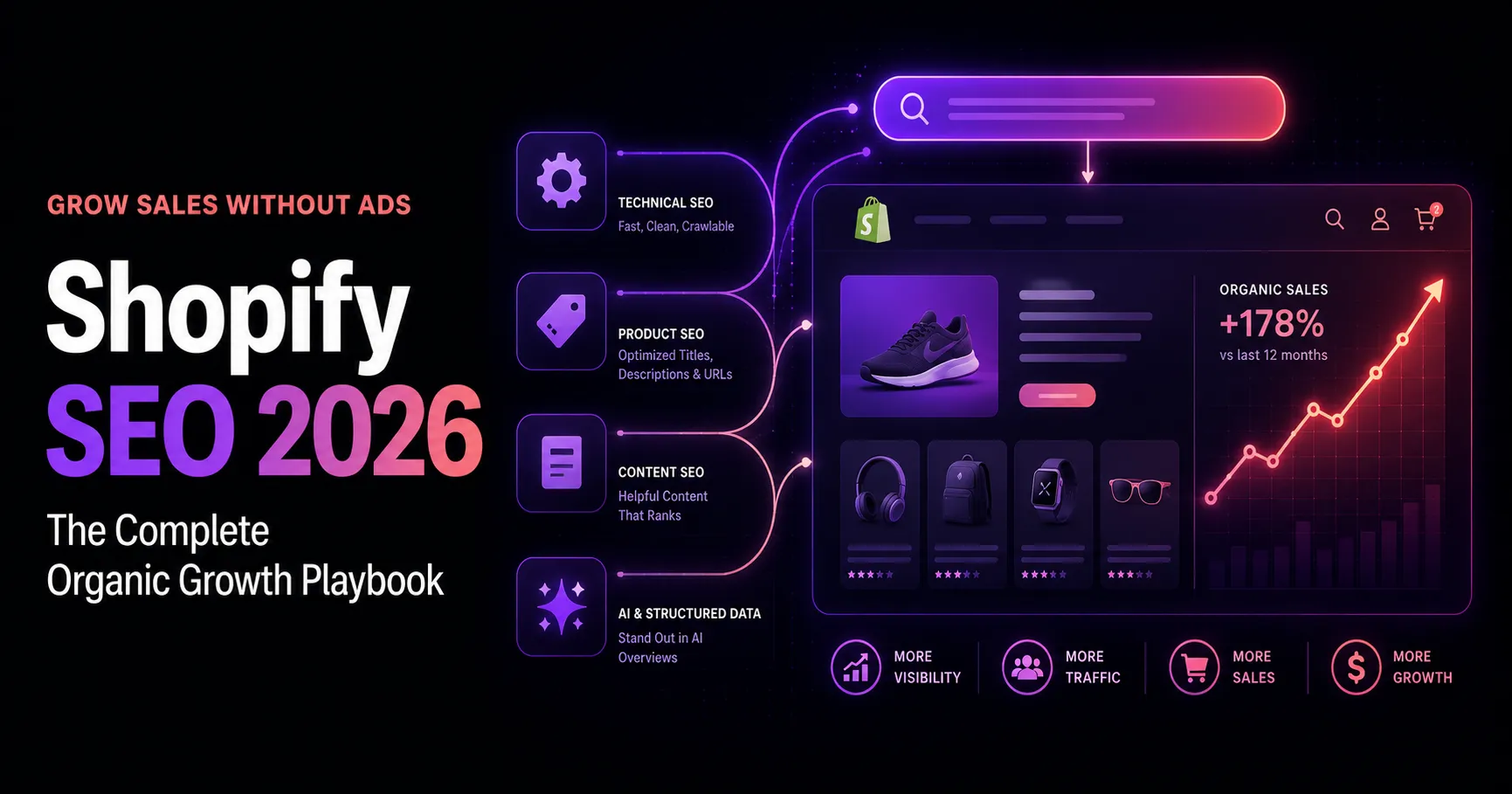
A Shopify storefront dashboard with a rising organic-traffic graph and a four-pillar SEO framework (technical, pages, content, AI visibility) flowing into search results, in the RankBrain Solutions purple-to-coral gradient theme

Why Organic Is the Best Growth Channel You're Ignoring

Most Shopify founders we meet have the same growth model: pour money into Meta and Google ads, watch the revenue climb, then watch the margin disappear as ad costs creep up every quarter. It works until it doesn't. The day you pause spend, the traffic stops cold.

Organic search is the opposite. It compounds. A collection page that ranks today keeps selling next month, next quarter, and next year — with no incremental cost per click. And in 2026, with paid acquisition more expensive than ever, that compounding is the difference between a brand that scales profitably and one that's renting its customers.

Here's the scale of the opportunity. Shopify processed $378.4 billion in GMV in 2025, up 29.5% year over year, and now powers more than 14% of US ecommerce, according to its Q4 2025 earnings (Digital Commerce 360, February 2026). That's a massive, growing pie — and the merchants taking the biggest organic slices aren't the ones with the biggest budgets. They're the ones with the best SEO.

This is the complete playbook we use with 7- and 8-figure Shopify brands. Not generic "add keywords to your titles" advice — the actual frameworks, templates, and step-by-step systems that move organic revenue. Technical fixes, collection and product page optimization, content clusters, schema, internal linking, and the AI search work that's becoming non-negotiable.

If you sell on Shopify and you're tired of being a hostage to your ad account, this is for you. Let's build a channel you actually own.

Key Takeaways

  • Shopify hit $378.4B GMV in 2025 (+29.5% YoY) and powers 14%+ of US ecommerce — organic is a huge, compounding channel (Digital Commerce 360, 2026).
  • Collection pages — not product pages — are usually the biggest untapped organic revenue source for Shopify stores.
  • Speed, schema, internal linking, and AI search readiness now matter as much as keywords. This playbook covers all of it with templates you can copy.

Why Shopify SEO Is Different in 2026

Shopify SEO in 2026 is different because the platform's structural quirks now collide with two big shifts: rising ad costs pushing brands back to organic, and AI search reshaping how shopping queries get answered. AI Overviews already appear on roughly 14% of shopping and transactional queries — up from about 2% a year earlier, a near-600% jump per Semrush data (DesignRush, February 2026). The game changed, and most Shopify guides haven't caught up.

Let's be specific about what makes Shopify SEO its own discipline.

Shopify's structural quirks

Shopify is brilliant for selling and frustrating for SEO out of the box. A few realities you have to manage:

  • Forced URL structure. Shopify locks you into /products/, /collections/, and /pages/ paths. You can't flatten them, so you optimize within them.
  • Duplicate content by design. Products accessible through multiple collections generate duplicate URLs like /collections/sale/products/item. Left unmanaged, this dilutes your rankings — we cover the full fix in our Shopify duplicate content guide.
  • Limited robots.txt and template control. You have access now, but it's narrower than a custom build, so technical SEO requires Shopify-specific workarounds.
  • Theme-driven rendering. Your theme decides your heading structure, schema, and speed — and most themes ship with SEO gaps you have to close manually.

The two forces reshaping the game

First, paid acquisition keeps getting pricier. Shopping ad CPCs and Meta CPMs climbed through 2025, squeezing the unit economics that DTC brands were built on. Organic doesn't have a CPC, so every profitable order it drives widens your margin.

Second, AI search is intercepting shopping research. Buyers ask ChatGPT and Google's AI Mode "what's the best X for Y" before they ever hit a product page. If your store isn't structured to be cited in those answers, you're invisible at the exact moment the decision gets made. Here's the reassuring part: organic search still drives the overwhelming majority of trackable site traffic and converts better than AI referrals today (BrightEdge, March 2026). So you optimize for both — classic organic now, AI citation in parallel. We'll do exactly that.

The Modern Shopify SEO Framework

A Shopify store that wins organically rests on four pillars — Technical Foundation, Page Optimization, Content Authority, and AI Visibility — and they have to be built in that order. Skipping the foundation to chase content is the most common reason stores plateau. With organic search historically driving over half of all website traffic (BrightEdge, the most-cited channel benchmark), getting this sequence right is what separates compounding growth from spinning wheels.

Here's the framework we run on every engagement. Think of it as a pyramid: each pillar supports the next.

Pillar 1 — Technical Foundation

This is the plumbing: site speed, crawlability, indexation, duplicate content control, mobile experience, and clean architecture. If Google and AI crawlers can't efficiently access and understand your store, nothing else you do matters. Fix this first, always.

Pillar 2 — Page Optimization

This is where revenue lives. Collection pages and product pages are your money pages, and optimizing their titles, descriptions, headings, content, and schema is the highest-ROI work on the entire site. Most stores treat these as an afterthought. Big mistake.

Pillar 3 — Content Authority

Your blog and informational content build topical authority, capture top-of-funnel demand, and feed internal links to your money pages. Done well, content turns your store into the obvious expert in your category — which is exactly what both Google and AI engines reward.

Pillar 4 — AI Visibility

The newest pillar, and the one creating the widest gaps between competitors right now. This is optimizing so AI Overviews, ChatGPT, and Perplexity cite your store when buyers research purchases. It builds on the first three pillars — you can't be AI-cited if your technical and content foundations are weak.

The rest of this playbook walks through each pillar with the specific tactics, templates, and checklists to execute it. Ready? Start at the foundation.

Technical Shopify SEO Checklist (Pillar 1)

Technical SEO is the highest-leverage work on a Shopify store because speed and crawlability directly affect both rankings and conversions. The data here is unambiguous: Portent found ecommerce conversion rates are 2.5x higher at a one-second load time than at five seconds — 3.05% versus 0.67% — across 5.6 million sessions (Portent, 2022). Every second of delay is revenue walking out the door.

Work through this checklist top to bottom. The items are ordered by impact.

Speed and Core Web Vitals

  • ✅ Compress and serve images in WebP; lazy-load below-the-fold media
  • ✅ Audit and remove unused apps — each one injects scripts that slow your store
  • ✅ Minimize third-party scripts (chat widgets, pop-ups, trackers) and defer non-critical JS
  • ✅ Choose a lightweight, well-coded theme; bloated themes are a hidden tax on every page
  • ✅ Hit "good" Core Web Vitals (LCP under 2.5s, INP under 200ms, CLS under 0.1)

A 0.1-second improvement in load time lifted retail conversions by 8.4% in the Deloitte and Google "Milliseconds Make Millions" study (web.dev). Speed isn't a vanity metric — it's a revenue lever.

Crawlability and indexation

  • ✅ Submit your sitemap.xml to Google Search Console and Bing Webmaster Tools (Bing feeds ChatGPT)
  • ✅ Use noindex on thin, low-value pages (cart, account, internal search results, tag pages)
  • ✅ Confirm important pages aren't accidentally blocked in robots.txt or by an app
  • ✅ Keep your important pages within three clicks of the homepage

Duplicate content control

  • ✅ Ensure canonical tags point products to their primary URL, not collection-nested duplicates
  • ✅ Avoid linking to /collections/x/products/y URLs internally — link to /products/y
  • ✅ Handle variant URLs and faceted navigation so they don't spawn thin duplicate pages

Mobile experience

Mobile commerce is around 59% of total retail ecommerce sales (Statista, 2025), and Google indexes mobile-first. If your mobile experience is slow or clunky, you're losing the majority of your buyers before they see a product.

For the deeper technical layer specific to Shopify's quirks, our complete Shopify SEO checklist for 2026 expands every item above into step-by-step fixes.

Collection Page Optimization Strategy (Pillar 2)

Collection pages are the single biggest organic revenue opportunity on most Shopify stores, because they target high-intent category keywords that individual products can't rank for. When someone searches "women's waterproof hiking boots," they want a selection — a category page — not one specific product. Yet most stores leave collection pages as bare grids of products with zero optimized content. That's leaving money on the table.

Here's how to turn collections into ranking, converting assets.

The collection page title and meta template

Use formulas, not guesswork. These are the templates we deploy:

  • Title tag: [Primary Category Keyword] – [Key Benefit/Modifier] | [Brand]
    Example: Women's Waterproof Hiking Boots – Grip & Comfort | TrailCo
  • Meta description: Shop [category] built for [use case]. [Proof point/benefit]. Free shipping over $X. [Soft CTA].
    Example: Shop women's waterproof hiking boots built for rough trails. Vibram soles, all-day comfort, 10,000+ 5-star reviews. Free shipping over $75.
  • H1: Match the primary keyword naturally — "Women's Waterproof Hiking Boots" — not your brand slogan

Add real content above and below the product grid

This is the highest-impact collection fix. Add a 50-100 word intro above the grid that answers the searcher's intent and uses the keyword naturally. Below the grid, add 200-400 words of genuinely useful content: buying guidance, what to look for, FAQs about the category. This gives Google and AI engines something to rank and cite — and helps shoppers choose.

Optimized collection page example

Picture a "Men's Merino Wool Socks" collection done right:

  • Above grid: One short paragraph — "Merino wool socks regulate temperature, resist odor, and cushion every step. Our collection is built for hiking, work, and everyday wear, with reinforced heels and a lifetime guarantee."
  • Product grid with clean, descriptive product titles
  • Below grid: A short buying guide — "How to choose merino socks," "Merino vs synthetic," "Care instructions" — each answering a real question, with internal links to relevant blog posts
  • FAQ block with FAQPage schema covering "Are merino wool socks worth it?" and similar queries

Collection page checklist

  • ✅ Keyword-targeted title tag, meta description, and H1
  • ✅ Intro content above the product grid (50-100 words)
  • ✅ Supporting content below the grid (200-400 words)
  • ✅ Logical product ordering (bestsellers and in-stock first)
  • ✅ Internal links to related collections and relevant blog posts
  • ✅ FAQ block with schema where it fits
  • ✅ Optimized, descriptive image alt text on collection imagery

Nail your top 10 collection pages and you've usually captured the majority of your category-level organic upside. Start there before touching anything else in this pillar.

Product Page SEO That Actually Converts (Pillar 2)

Product page SEO works best when you optimize for the specific, long-tail, high-intent queries buyers use right before purchase — and pair that with conversion elements that turn the click into a sale. Ranking a product page is pointless if it doesn't convert, so this is where SEO and CRO have to work as one. Structured data is central here, because rich results with price, availability, and ratings make your listing far more clickable.

Let's build a product page that ranks and sells.

The product page title and description template

  • Title tag: [Product Name] – [Key Attribute/Benefit] | [Brand]
    Example: Alpine 200 Merino Hiking Socks – Cushioned, Odor-Resistant | TrailCo
  • Meta description: Lead with the core benefit, add a proof point and a reason to click — "Stay dry and blister-free on long hikes. Reinforced heel, lifetime guarantee, 4.9★ from 2,300 reviews. Free shipping over $75."

Write unique, benefit-led product descriptions

Never ship manufacturer boilerplate — it's duplicate content that competes with every other store selling the same item. Write original descriptions that lead with benefits, answer real objections, and naturally include the terms buyers search. Aim for 150-300 words of genuinely useful copy, not keyword soup.

Structure the page for extraction and conversion

Both shoppers and AI engines reward clear structure:

  • Clear H1 with the product name
  • Bulleted key features near the top — scannable and extractable
  • Specs table for materials, dimensions, and care — AI systems extract tables with high accuracy
  • Real reviews on-page (they add fresh, unique content and power review rich results)
  • A product FAQ answering common pre-purchase questions

Optimized product page example

Our "Alpine 200 Merino Hiking Socks" page would have: a benefit-led H1 and intro, five scannable feature bullets, a specs table (70% merino / 30% nylon, midweight, machine washable), a 4-question FAQ ("Do they shrink?", "How warm are they?"), 2,300 visible reviews, and complete Product schema with price, availability, and aggregateRating. That's a page built to rank, get cited, and convert.

Product page checklist

  • ✅ Keyword + benefit title tag and compelling meta description
  • ✅ Unique 150-300 word description (no manufacturer boilerplate)
  • ✅ Scannable feature bullets and a specs table
  • ✅ Product schema with price, availability, and aggregateRating
  • ✅ Descriptive image alt text including the product name
  • ✅ On-page reviews and a pre-purchase FAQ
  • ✅ Internal links to the parent collection and complementary products

Shopify Blog Content Strategy (Pillar 3)

A Shopify blog earns its keep when it's built as topic clusters that capture research-stage demand and funnel internal authority to your collection and product pages — not as a graveyard of random posts. Content is also how you become the source AI engines cite, since the original GEO research found that adding statistics and authoritative citations can lift AI visibility by 40% or more (Aggarwal et al., KDD 2024). Random posts don't do that. Clusters do.

Here's how to build content that actually drives sales.

The topic cluster model

Stop publishing one-off posts. Build clusters: one comprehensive "hub" page on a broad topic, surrounded by "spoke" posts answering specific sub-questions, all interlinked. This signals topical authority and concentrates ranking power.

Content cluster example

For our merino sock store, a cluster looks like this:

  • Hub: "The Complete Guide to Merino Wool for Outdoor Gear" (broad, comprehensive)
  • Spoke: "Are Merino Wool Socks Worth It? An Honest Breakdown" → links to the socks collection
  • Spoke: "Merino vs Synthetic Base Layers: Which Wins?" → links to relevant products
  • Spoke: "How to Wash Merino Wool So It Lasts for Years" → links to care-related products
  • Spoke: "Best Socks for Hiking in Cold Weather (2026)" → links straight to the collection

Every spoke links up to the hub and over to the relevant money page. The hub links down to every spoke. That's the entire architecture, and it works.

Match content to buyer intent

Map posts to the funnel so the blog feeds revenue:

  • Top of funnel: "How to choose…", "Guide to…" — capture researchers early
  • Middle: "X vs Y", "Best X for Y" — capture comparison shoppers and link hard to collections
  • Bottom: "Is X worth it", buying guides — capture near-ready buyers and link to products

Write for humans and AI at once

Lead each section with a direct answer, back it with specific data and sources, use clear headings and lists, and keep paragraphs short. This is the format that ranks, earns featured snippets, and gets cited by AI — all at the same time. For the deeper AI angle, see our complete guide to Generative Engine Optimization.

The Shopify Internal Linking Blueprint (Pillar 3)

Internal linking is the most underrated Shopify SEO lever — it tells search engines which pages matter, spreads ranking authority, and guides shoppers toward purchase. Most stores have almost no intentional internal linking beyond their nav menu, which means ranking power pools on the homepage instead of flowing to the collection and product pages that actually generate revenue. A deliberate blueprint fixes that.

Here's the structure we implement.

The internal linking hierarchy

  • Homepage → top collections (your most valuable category pages)
  • Collections → related collections and their key products
  • Products → parent collection, complementary products, and relevant guides
  • Blog hub → all its spokes
  • Blog spokes → the hub, related spokes, and the money page they support

The internal linking framework (rules)

  • Descriptive anchor text. Use "women's waterproof hiking boots," never "click here" or "this collection."
  • Link from content, not just nav. Contextual links inside body copy carry more weight and intent.
  • Point to money pages. Every blog post should link to at least one collection or product it naturally supports.
  • Three-click rule. Keep every important page reachable within three clicks of the homepage.
  • Link to the canonical URL. Always /products/item, never a collection-nested duplicate.

The "money page" link audit

Run this quarterly. List your top 10 revenue pages, then count the internal links pointing to each. Your highest-value pages should have the most internal links — if a top collection has only two internal links while a blog post has fifteen, your authority is flowing the wrong way. Rebalance by adding contextual links from relevant content and related collections. This single audit often unlocks rankings that were stuck for months.

Shopify Schema Markup Guide (Pillar 2 & 4)

Schema markup is structured data that tells search engines and AI systems exactly what your pages are — and for Shopify stores, it's the difference between a plain blue link and a rich result with price, ratings, and availability. It's also increasingly how AI engines decide what to cite, which is why complete schema sits at the intersection of classic SEO and AI visibility. Google confirms the mechanism: structured data is what earns product rich results in search.

Here are the schema types every Shopify store should deploy.

Priority schema types for Shopify

  • Product schema — name, description, price, currency, availability, and brand. Powers product rich results. Essential on every product page.
  • AggregateRating & Review schema — the star ratings that dramatically boost listing visibility and click-through.
  • BreadcrumbList schema — shows your site hierarchy in results and reinforces structure.
  • Organization schema — establishes your brand entity with logo and social profiles (sameAs links), which AI systems use for entity recognition.
  • FAQPage schema — on collection and product FAQs, makes your Q&A directly extractable by AI and eligible for rich results.
  • Article/BlogPosting schema — on every blog post, with author and dateModified.

How to implement it on Shopify

You have three routes, in order of control:

  • Theme edits: Add JSON-LD directly to your theme's Liquid templates — the cleanest, most reliable method if you have dev resources.
  • SEO apps: Schema apps automate it, but audit their output — they often produce incomplete or duplicate markup.
  • Hybrid: Use an app for breadth, then hand-tune product and FAQ schema for accuracy.

Always validate

Run every template through Google's Rich Results Test and the Schema.org validator. Broken schema can be worse than none — it signals inconsistency. Themes and apps frequently break markup during updates, so make validation a quarterly habit. For the complete, code-level playbook tuned for AI search, see our schema markup for AI search guide.

AI Search & GEO Optimization for Shopify (Pillar 4)

AI search optimization for Shopify means structuring your store so ChatGPT, Perplexity, and Google's AI Overviews recommend your products when buyers ask shopping questions — a channel that barely existed two years ago and is now reshaping how purchases get researched. AI Overviews already trigger on around 14% of shopping queries, up roughly 6x in a year (Semrush data via DesignRush, 2026). When a shopper asks "what's the best merino sock brand for hiking," you want to be the answer.

Here's how Shopify stores earn AI recommendations.

Make your store crawlable by AI

First, don't lock the door. Confirm your robots.txt and any firewall or CDN bot settings aren't blocking GPTBot, OAI-SearchBot, or Google's AI crawlers. Plenty of stores block them by accident and wonder why they're never cited. Get indexed on Bing, too — it powers ChatGPT Search retrieval.

Structure content for AI extraction

  • Answer-first copy on collections, products, and posts — lead with the direct answer to the buyer's question.
  • Specs tables and feature bullets — AI extracts structured data far more accurately than prose.
  • Complete Product, Review, and Organization schema — the entity signals AI uses to understand and trust your store.
  • Specific, sourced claims — "regulates temperature from 30°F to 80°F," not "great for any weather."

Build brand co-occurrence

AI engines recommend brands they "know." Get your store mentioned in editorial roundups, "best of" lists, review sites, and relevant communities. These mentions — linked or not — shape whether an AI considers you a credible option in your category. It's the hardest factor to fake and the most durable to own.

Mind the agentic shift

Shopify itself is leaning in. Its Winter 2026 edition added agentic storefront controls so merchants can influence how their brand appears inside AI assistants, and agentic checkout is emerging across the ecosystem. The takeaway: structured, well-described, schema-rich product data is becoming the input that AI shopping agents act on. Stores that get this right now will be the defaults those agents reach for. Our guides on getting Shopify products into ChatGPT and Shopify AI search optimization go deep on the tactics.

Common Shopify SEO Mistakes (And How to Fix Them)

The mistakes that quietly cap Shopify organic growth are almost always fixable in days, not months — but most stores never spot them because the dashboards still look fine. Given that a one-second speed difference can mean 2.5x the conversion rate (Portent, 2022), these aren't minor housekeeping items — they're revenue. Here are the ones we see most, with the fix for each.

Mistake 1: Thin or missing collection content

Fix: Add optimized intro and supporting content to your top collection pages using the templates above. This is usually the single biggest quick win on a Shopify store.

Mistake 2: Manufacturer boilerplate product descriptions

Fix: Rewrite descriptions for your bestsellers first. Unique, benefit-led copy beats duplicate boilerplate every time, and you only need to start with the products that drive revenue.

Mistake 3: Ignoring duplicate content from collection-nested URLs

Fix: Confirm canonicals and link to clean /products/ URLs internally. See our duplicate content guide for the full process.

Mistake 4: App bloat slowing the store

Fix: Audit every installed app, remove what you don't actively use, and check the script weight of what remains. Speed is conversion.

Mistake 5: No internal linking strategy

Fix: Implement the linking blueprint above. Point authority at your money pages with descriptive, contextual links.

Mistake 6: Treating the blog as separate from the store

Fix: Build clusters that link directly to collections and products. Content that doesn't feed revenue is a hobby, not a strategy.

Mistake 7: Zero schema or broken schema

Fix: Deploy and validate Product, Review, and Organization schema. Rich results lift clicks; missing schema leaves you with plain links.

Mistake 8: Ignoring AI search entirely

Fix: Unblock AI crawlers, index on Bing, structure content for extraction, and build brand mentions. The window to claim AI citations cheaply is open now.

Your 90-Day Shopify SEO Roadmap

This 90-day roadmap sequences the entire playbook into a realistic, phased plan that delivers quick wins early and compounding growth over time. We use this exact cadence with new Shopify clients because it front-loads the fixes that move revenue fastest while building the foundation for durable rankings. Work the phases in order — each builds on the last.

1. Days 1–30: Foundation & Quick Wins

Fix the plumbing and grab the fast revenue. In month one: run a full technical audit, fix Core Web Vitals and speed issues, remove app bloat, confirm canonicals and indexation, submit sitemaps to Google and Bing, and unblock AI crawlers. Then optimize your top 10 collection pages with the title, meta, and content templates — this is your biggest quick win. Set up Search Console and baseline tracking for impressions-to-clicks, not just rankings.

2. Days 31–60: Page Optimization & Schema

Go deep on money pages. Rewrite descriptions for your top 30 products, structure them with feature bullets and specs tables, and add pre-purchase FAQs. Deploy and validate Product, Review, Organization, and Breadcrumb schema across the store. Build out the internal linking blueprint, pointing authority at your top revenue pages. Run the money-page link audit and rebalance.

3. Days 61–90: Content Authority & AI Visibility

Build the compounding engine. Launch your first one or two topic clusters — a hub plus three to five spokes — each linking to the collections and products they support. Structure all content answer-first for AI extraction, add FAQPage schema, and start a brand-mention push (roundups, reviews, communities) to build co-occurrence. Begin manual prompt testing in ChatGPT and Google AI Mode to track your AI visibility, and set a quarterly refresh cycle for your priority pages.

By day 90 you'll have a technically sound store, optimized money pages, a content engine, and AI search readiness — the complete four-pillar foundation. From there, it compounds. For a more granular AI-specific sequence, pair this with our 90-day AI ranking playbook.

The Complete Shopify SEO Audit Checklist

Run this audit checklist quarterly to catch regressions, find new opportunities, and keep your store ahead of competitors. SEO isn't set-and-forget — themes break schema, apps slow things down, and rankings drift. A disciplined quarterly audit is what separates stores that compound from stores that plateau. Work through each section and score yourself honestly.

Technical

  • ✅ Core Web Vitals "good" on mobile and desktop
  • ✅ No unnecessary apps slowing the store
  • ✅ Sitemap submitted to Google and Bing; no indexation errors
  • ✅ Canonicals correct; no collection-nested duplicate URLs indexed
  • ✅ AI crawlers (GPTBot, OAI-SearchBot, Google) not blocked
  • ✅ Thin pages (cart, account, internal search) set to noindex

Collection pages

  • ✅ Optimized title, meta, and H1 on every key collection
  • ✅ Intro and supporting content present (not bare grids)
  • ✅ Internal links to related collections and relevant posts
  • ✅ FAQ blocks with schema where relevant

Product pages

  • ✅ Unique, benefit-led descriptions (no boilerplate)
  • ✅ Feature bullets, specs table, and pre-purchase FAQ
  • ✅ Valid Product + Review schema with price and availability
  • ✅ Descriptive image alt text
  • ✅ Links to parent collection and complementary products

Content & links

  • ✅ Topic clusters built around buyer intent
  • ✅ Every post links to a money page
  • ✅ Top revenue pages have the most internal links
  • ✅ Descriptive anchor text throughout

AI & brand

  • ✅ Content structured answer-first for extraction
  • ✅ Organization schema with sameAs links live
  • ✅ Consistent brand info across all profiles
  • ✅ Active brand mentions across third-party sites
  • ✅ Manual prompt tests run on priority shopping queries

If you're ticking fewer than 80% of these boxes, there's clear, prioritized revenue waiting in the gaps.

Frequently Asked Questions

How long does Shopify SEO take to show results?

Quick wins like optimizing collection pages and fixing speed can move traffic within 4-8 weeks. Meaningful, compounding organic growth typically takes 3-6 months, and topical authority builds over 6-12 months. The timeline depends on your starting point, competition, and how consistently you execute. SEO is slower than ads to start but far cheaper and more durable once it compounds.

Is Shopify good for SEO in 2026?

Yes, Shopify is strong for SEO when configured correctly. It offers fast hosting, clean (if rigid) URL structures, mobile-responsive themes, and now powers over 14% of US ecommerce (Digital Commerce 360, 2026). Its quirks — forced URL paths and duplicate content from collection-nested products — are manageable with the fixes in this guide. The platform isn't the limitation; the configuration usually is.

What are the most important Shopify SEO ranking factors?

The biggest levers are site speed and Core Web Vitals, optimized collection and product pages, unique content, complete schema markup, strong internal linking, and topical authority from content. Speed alone is decisive — conversion rates are 2.5x higher at a one-second load versus five seconds (Portent, 2022). In 2026, AI search readiness joins the list as a growing factor.

How do I optimize Shopify collection pages for SEO?

Optimize the title tag, meta description, and H1 around the category keyword, then add 50-100 words of intro content above the product grid and 200-400 words of buying guidance below it. Include internal links to related collections and posts, add an FAQ block with schema, and order products logically. Collection pages target high-intent category searches and are usually the biggest organic opportunity on a Shopify store.

Can I do Shopify SEO without hiring an agency?

Absolutely — this playbook is a complete DIY roadmap, and many merchants execute it successfully. The trade-off is time and expertise: technical fixes, schema, and AI optimization have a learning curve, and mistakes can cost months. Many founders DIY the quick wins and bring in a specialist for the technical and strategic work. If you want a prioritized starting point, request a free audit to see where your effort pays off fastest.

How is Shopify SEO different from regular SEO?

Shopify SEO works within the platform's structural constraints — forced URL paths, collection-nested duplicate content, theme-driven schema and speed — and centers on ecommerce-specific pages (collections and products) rather than just articles. It also weights conversion heavily, since ranking a product page only matters if it sells. The fundamentals of content, links, and technical health still apply, but the execution is ecommerce-specific.

Should Shopify stores optimize for ChatGPT and AI search?

Yes, and increasingly so. AI Overviews now appear on around 14% of shopping queries, up roughly 6x in a year (Semrush via DesignRush, 2026), and buyers research purchases in ChatGPT before visiting stores. Optimizing for AI — crawler access, schema, answer-first content, and brand mentions — builds on your classic SEO foundation and captures demand at the moment of decision. The window to claim AI citations cheaply is open now.

Build the Channel You Actually Own

Organic search is the one growth channel that compounds instead of disappearing the moment you stop paying — and for Shopify stores in 2026, it's the clearest path to profitable, durable growth. With Shopify powering 14%+ of US ecommerce and ad costs climbing, the merchants who win the next few years will be the ones who built organic into a moat (Digital Commerce 360, 2026).

Here's the playbook in one breath:

  • Pillar 1 — Technical: fast, crawlable, duplicate-free, mobile-first.
  • Pillar 2 — Pages: optimized collections and products with content, schema, and conversion built in.
  • Pillar 3 — Content: topic clusters that build authority and feed money pages through smart internal linking.
  • Pillar 4 — AI Visibility: structured, citable, brand-known across AI search.

Start with the technical foundation and the quick wins on your top collection pages — that's where the fastest revenue hides. Then build outward, one pillar at a time, following the 90-day roadmap. You don't need a bigger ad budget. You need a channel you own.

If you'd rather have a team that's done this for 7- and 8-figure brands run it for you, our Shopify SEO service handles the whole playbook end to end.

Shopify SEO 2026Ecommerce SEOShopify SEO GuideProduct Page SEOShopify Collections SEOShopify Technical SEOShopify Schema MarkupShopify AI Search Optimization

Share This Blog

Let's Discuss Your Project

Get a free SEO strategy tailored to your business.

We respond within 24 hours

Chandni Dave

About Author

Chandni DaveCEO & SEO Consultant

Chandni is the founder of RankBrain Solutions, specializing in AI search optimization, technical SEO, and data-driven growth strategies for businesses worldwide.

Ready to Optimize for AI Search?

Book a free strategy call with our SEO experts to discuss how we can help your business rank in AI-powered search results.